







EN 1.4713: Ferritic Steel Specs & Applications
Apr 07, 2026
Leave a message
1.4713 stainless steel, commonly known as X10CrAlSi13 or UNS S13300, is a ferritic heat-resistant stainless steel with excellent oxidation resistance at elevated temperatures due to its chromium and aluminum content. The addition of aluminum promotes the formation of a highly stable, adherent aluminum oxide scale that provides superior protection against scaling and oxidation in high-temperature environments. This makes it an ideal material for applications requiring good high-temperature performance without the need for high nickel content, such as furnace components, heat treatment equipment, and automotive exhaust systems.
Equivalent specifications for 1.4713 stainless steel
| Standard | Equivalent Grade |
|---|---|
| EN (Europe) | 1.4713 |
| ASTM/AISI (USA) | X10CrAlSi13, UNS S13300 |
| Common Name | Chromium-aluminum steel |
Chemical composition of 1.4713 stainless steel
| Element | C | Si | Mn | P | S | Cr | Al |
|---|---|---|---|---|---|---|---|
| Content (%) | ≤ 0.12 | 0.70 - 1.40 | ≤ 1.0 | ≤ 0.04 | ≤ 0.03 | 12.0 - 14.0 | 0.70 - 1.20 |
Properties of 1.4713 Stainless Steel
| Property | Yield Strength (Rp0.2) | Tensile Strength (Rm) | Elongation (A) | Hardness (HB) |
|---|---|---|---|---|
| Typical Value (Room Temp) | ≥ 250 MPa | 450 - 600 MPa | ≥ 20% | ≤ 200 |
| Typical Value (800°C) | ~ 30 MPa | ~ 40 MPa | ~ 40% | - |
Key Characteristics and Applications of 1.4713 / X10CrAlSi13
Excellent High-Temperature Oxidation Resistance: The aluminum content (0.70-1.20%) promotes the formation of a stable aluminum oxide scale that provides superior resistance to scaling and oxidation up to approximately 900°C (1650°F).
Good Thermal Fatigue Resistance: The ferritic structure provides good resistance to thermal cycling, making it suitable for applications with repeated heating and cooling.
Low Cost: Absence of nickel and low alloy content makes it significantly more economical than austenitic heat-resistant grades.
Magnetic and Weldable with Care: Strongly magnetic and can be welded with proper procedures, though preheating may be required.
Primary Applications:
Furnace Components: Heating elements, furnace linings, burner parts, and support grids.
Heat Treatment Equipment: Retorts, muffles, and baskets for heat treating operations.
Automotive Exhaust: Catalytic converter supports, exhaust manifolds, and heat shields.
Household Appliances: Burner components in gas stoves, heater parts, and fireplace inserts.
Industrial Heating: Radiant tubes and heating element sheaths.
Petrochemical: Components in moderate-temperature process equipment.
How does 1.4713 compare to 1.4762 (446) and 1.4742 (X10CrAlSi18)?
1.4713 has lower chromium content (12-14%) compared to 1.4762 (446) which has 23-27% Cr, and 1.4742 (X10CrAlSi18) which has 17-19% Cr. This results in lower maximum service temperature: 1.4713 is suitable up to ~900°C, while 1.4762 can be used up to ~1100°C. The aluminum content provides additional oxidation resistance across all three grades. 1.4713 is more economical due to lower chromium content and is often chosen for applications with moderate temperature requirements (up to 900°C). For higher temperature applications (above 900°C), 1.4762 or 1.4742 with higher chromium content are recommended.
What are the welding considerations for 1.4713?
What temperature range is 1.4713 suitable for?
Looking for a Reliable Supplier of 1.4713 Stainless Steel?
GNEE Steel supplies cost-effective 1.4713 (X10CrAlSi13) stainless steel in plate, sheet, bar, and strip forms for moderate-temperature heat-resistant applications. We provide full material certification (EN 10204 3.1) and processing support including cutting, forming, and welding services. If you have any requirements, please feel free to contact us.
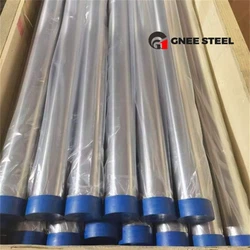
1.4713 stainless steel pipes

1.4713 stainless steel bars

1.4713 stainless steel coils
Send Inquiry