







Stainless Steels - Introduction To The Grades And Families
Apr 09, 2026
Leave a message



The Families Of Stainless Steels
Stainless steels are iron-based alloys containing a minimum of about 10.5% chromium; this forms a protective self-healing oxide film, which is the reason why this group of steels has their characteristic "stainlessness" or corrosion resistance. The ability of the oxide layer to heal itself means that the steel is corrosion resistant, no matter how much of the surface is removed. This is not the case when carbon or low alloy steels are protected from corrosion by metallic coatings such as zinc or cadmium or by organic coatings such as paint.
Although all stainless steels depend on the presence of chromium, other alloying elements are often added to enhance their properties. The categorisation of stainless steels is unusual amongst metals in that it is based upon the nature of their metallurgical structure - the terms used denote the arrangement of the atoms which make up the grains of the steel, and which can be observed when a polished section through a piece of the material is viewed at high magnification through a microscope. Depending upon the exact chemical composition of the steel the microstructure may be made up of the stable phases austenite or ferrite, a "duplex" mix of these two, the phase martensite created when some steels are rapidly quenched from a high temperature, or a structure hardened by precipitated micro-constituents.
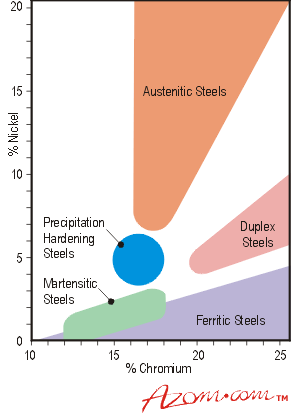
The relationship between the different families is as shown in Figure 1. A broad brush comparison of the properties of the different families is given in Table 1.
|
|
|
Figure 1. Families of stainless steels. |
Austenitic Stainless Steels
This group contains at least 16% chromium and 6% nickel (the basic grade 304 is referred to as 18/8) and range through to the high alloy or "super austenitics" such as 904L and 6% molybdenum grades.
Additional elements can be added such as molybdenum, titanium or copper, to modify or improve their properties, making them suitable for many critical applications involving high temperature as well as corrosion resistance. This group of steels is also suitable for cryogenic applications because the effect of the nickel content in making the steel austenitic avoids the problems of brittleness at low temperatures, which is a characteristic of other types of steel.
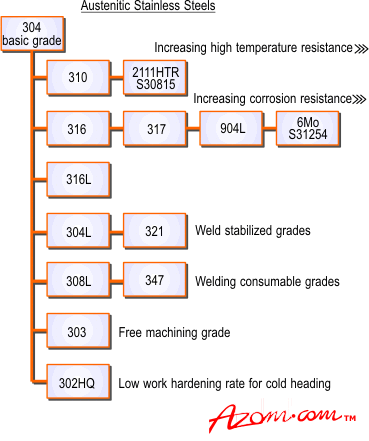
The relationship between the various austenitic grades is shown in Figures 2.
|
|
Send Inquiry