







What is 1.4108 material equivalent to?
Apr 07, 2026
Leave a message
1.4108 stainless steel, commonly known as 420F or UNS S42020, is a free-machining martensitic stainless steel designed for high-speed machining applications requiring moderate corrosion resistance and the ability to be hardened to high strength levels. With its sulfur addition to improve machinability, it offers significantly better machinability than standard 420 while maintaining good mechanical properties and heat treatability. It is the material of choice for precision components requiring complex machining operations, such as screws, bolts, shafts, and valve parts, where both machinability and hardenability are important.
Equivalent Grade to 1.4108 Stainless Steel
| Standard | Equivalent Grade |
|---|---|
| EN (Europe) | 1.4108 |
| ASTM/AISI (USA) | 420F, UNS S42020 |
| JIS (Japan) | SUS420F |
| Common Name | 420F |
Chemical Composition of 1.4108 Stainless Steel
| Element | C | Si | Mn | P | S | Cr | Mo (optional) |
|---|---|---|---|---|---|---|---|
| Content (%) | 0.30 - 0.40 | ≤ 1.0 | ≤ 1.25 | ≤ 0.06 | ≥ 0.15 | 12.0 - 14.0 | ≤ 0.60 |
Physical Properties (20 ℃ room temperature) of 1.4108 Stainless Steel
| Condition | Yield Strength (Rp0.2) | Tensile Strength (Rm) | Elongation (A) | Hardness (HRC) |
|---|---|---|---|---|
| Annealed | ~ 380 MPa | ~ 690 MPa | ~ 15% | ~ 25 HRC |
| Hardened & Tempered | ≥ 540 MPa | ≥ 740 MPa | ≥ 12% | 48 - 55 HRC |
Key Characteristics and Applications of 1.4108 / 420F
Excellent Machinability: Sulfur addition provides significantly better machinability than standard 420, allowing for higher cutting speeds, longer tool life, and better surface finishes in automatic screw machine operations.
High Hardness and Wear Resistance: Can be heat treated to achieve high hardness (48-55 HRC), providing good wear resistance and edge retention for cutting applications.
Moderate Corrosion Resistance: Provides reasonable resistance to water, mild chemicals, and atmospheric conditions, but is not suitable for severe corrosive environments.
Magnetic and Hardenable: Strongly magnetic and responds well to heat treatment for hardening, with good through-hardening capability.
Primary Applications:
Fasteners and Fittings: Screws, bolts, nuts, and threaded components produced via high-speed machining.
Precision Components: Gears, shafts, valve stems, and instrument parts requiring good machinability and hardenability.
Cutlery and Blades: Knives, scissors, and industrial blades requiring moderate corrosion resistance.
Surgical Instruments: Dental tools and surgical instruments requiring good edge retention.
General Engineering: Components where machinability is prioritized while maintaining hardenability.
How does 420F (1.4108) compare to 420 (1.4021) and 416 (1.4005)?
420F offers a balance between the properties of 420 and 416. Compared to standard 420, 420F provides significantly better machinability (approximately 80% of B1112 vs. 60% for 420) due to its sulfur addition, but with slightly lower corrosion resistance. Compared to 416, 420F has higher carbon content (0.30-0.40% vs. ≤0.15%), allowing it to achieve much higher hardness (55 HRC vs. 40 HRC) and better wear resistance. 420F is often chosen for applications requiring both good machinability and high hardness, while 416 is preferred for maximum machinability, and 420 for maximum hardness without the machinability requirement.
How does the sulfur content affect the corrosion resistance of 420F?
The high sulfur content (≥0.15%) that improves machinability also forms manganese sulfide inclusions, which can act as initiation sites for pitting corrosion. This reduces the overall corrosion resistance compared to standard 420. Therefore, 420F is not recommended for highly corrosive environments, applications requiring high surface finish integrity for corrosion resistance, or where the component will be exposed to chlorides, acids, or marine conditions. For such applications, standard 420 or other grades with better corrosion resistance should be considered.
What are the heat treatment recommendations for 420F?
Typical heat treatment for 420F involves:
Hardening: Austenitize at 980-1030°C, hold for sufficient time, then oil quench
Tempering: Temper immediately after quenching at 150-370°C depending on desired hardness
Lower tempering temperatures (150-250°C): Maximum hardness (52-55 HRC)
Higher temperatures (300-370°C): Slightly lower hardness with improved toughness
Avoid tempering between 400-550°C due to embrittlement
Annealing: Heat to 830-880°C, cool slowly in furnace for maximum machinability
Double tempering is recommended for stress relief and dimensional stability
GNEE Steel supplies free-machining 420F (1.4108) stainless steel in bar, wire, and rod forms, ideal for high-volume machining applications requiring good hardenability. We provide full material certification (EN 10204 3.1) and processing support including precision cutting and machining services. If you have any requirements, please feel free to contact us.

1.4108 stainless steel tube
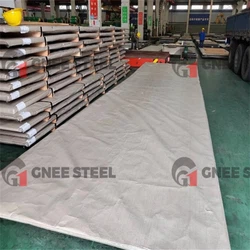
1.4108 Stainless steel plate

1.4108 stainless steel bar
Send Inquiry