







EN 1.4410 (F53) Super Duplex: High Corrosion‑Resistant Alloy
Apr 03, 2026
Leave a message
1.4410 stainless steel, commonly known as Super Duplex 2507 or UNS S32750, is a super duplex stainless steel with a balanced ferritic-austenitic microstructure that offers exceptionally high strength and outstanding corrosion resistance. With its high chromium, molybdenum, and nitrogen content, it provides superior resistance to pitting, crevice corrosion, and stress corrosion cracking in aggressive chloride environments, making it the material of choice for the most demanding offshore, chemical processing, and desalination applications.
Equivalent specifications for 1.4410 stainless steel
| Standard | Equivalent Grade |
|---|---|
| EN (Europe) | 1.4410 |
| ASTM/AISI (USA) | 2507, UNS S32750 |
| JIS (Japan) | SUS329J4L |
| Common Name | Super Duplex 2507 |
Chemical composition of 1.4410 stainless steel
| Element | C | Si | Mn | P | S | Cr | Ni | Mo | N |
|---|---|---|---|---|---|---|---|---|---|
| Content (%) | ≤ 0.03 | ≤ 0.80 | ≤ 1.2 | ≤ 0.035 | ≤ 0.02 | 24.0 - 26.0 | 6.0 - 8.0 | 3.0 - 5.0 | 0.24 - 0.32 |
Properties of 1.4410 Stainless Steel
| Property | Yield Strength (Rp0.2) | Tensile Strength (Rm) | Elongation (A) | Hardness (HB) | Impact (J) |
|---|---|---|---|---|---|
| Typical Value | ≥ 550 MPa | 750 - 1000 MPa | ≥ 25% | ≤ 310 | ≥ 80 (20°C) |
Key Characteristics and Applications of 1.4410 / Super Duplex 2507
Exceptional Corrosion Resistance: Possesses a very high Pitting Resistance Equivalent Number (PREN > 40), offering superb resistance to pitting, crevice corrosion, and stress corrosion cracking in aggressive chloride environments, including seawater and concentrated brines.
Very High Strength: Its duplex structure provides extremely high yield and tensile strength, enabling significant weight reduction and more cost-effective designs for pressure-containing parts.
Good Erosion and Wear Resistance: The ferritic phase contributes to good resistance against erosion-corrosion and abrasive wear, particularly important in high-velocity flow applications.
Excellent Fatigue Strength: Superior fatigue performance compared to austenitic grades, beneficial for dynamic loading applications.
Primary Applications:
Offshore & Marine: Subsea pipelines, Christmas trees, manifolds, flowlines, seawater cooling systems, propeller shafts, and riser systems.
Chemical Processing: Reactors, heat exchangers, columns, and piping for highly corrosive acids and chlorides.
Desalination & FGD Plants: High-pressure RO membranes, evaporator tubes, brine heater tubes, and scrubber systems.
Pulp & Paper Industry: Digesters, bleaching equipment, and handling systems for chloride-containing process streams.
Oil & Gas: Downhole tubing, process equipment, and topside piping in sour service environments.
Cargo Tanks: Chemical tankers and container vessels carrying corrosive cargoes.
How does Super Duplex 2507 (1.4410) differ from standard Duplex 2205 (1.4462)?
What are the critical factors for welding Super Duplex 2507 stainless steel?
What is the maximum service temperature for 2507 in chloride environments?
For continuous immersion in seawater or other chloride-containing environments, 2507 offers excellent performance up to approximately 60°C (140°F). Above this temperature, the risk of pitting and crevice corrosion increases, and more highly alloyed materials (such as super austenitic grades or nickel-based alloys) may be required. For non-immersed applications or where chlorides are not present, 2507 can be used at higher temperatures, but care must be taken to avoid prolonged exposure to temperatures above 300°C due to the risk of sigma phase embrittlement. For structural applications at elevated temperatures, the material retains good strength but corrosion resistance may be affected.
Looking for a Reliable Supplier of 1.4410 / Super Duplex 2507 Stainless Steel?

1.4410 stainless steel bars

1.4410 stainless steel plates
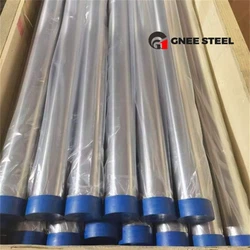
1.4410 stainless steel pipes
Send Inquiry