







6061 aluminum tube vs. 316 stainless steel tube: resistant to salt spray corrosion
Apr 11, 2025
Leave a message
In salt spray environments (such as marine, coastal industrial areas, or outdoor high-humidity conditions), corrosion primarily arises from chloride ions (Cl⁻) damaging the passive film on metal surfaces. Chloride ions are small and highly reactive, capable of penetrating oxide layers and adsorbing onto the metal surface, triggering pitting, crevice corrosion, or galvanic corrosion.
The difference in salt spray resistance between 6061 aluminum tubing and 316 stainless steel tubing is due to their distinct material properties and surface protection mechanisms.
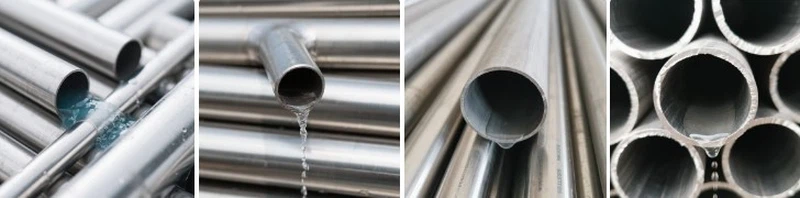
Comparison Table: 6061 Aluminum Tube vs. 316 Stainless Steel Tube for Salt Spray Resistance
| Comparison Dimension | 6061 Aluminum Tube (Requires Surface Treatment) | 316 Stainless Steel Tube (No Surface Treatment Needed) |
|---|---|---|
| Initial Salt Spray Resistance Time | 24–72 hours (untreated) → 500–1000 hours (treated) | ≥1000 hours (no obvious pitting corrosion) |
| Long-Term Maintenance Needs | Requires regular inspection of coating/oxidation film integrity | Virtually maintenance-free; only requires cleaning of surface salt deposits |
| Weight & Cost | Lightweight, cost-effective (suitable for large-scale lightweight applications) | Heavyweight, high-cost (suitable for high-reliability scenarios) |
| Mechanical Properties | Moderate strength (T6 temper yield strength ≥276MPa), good toughness | High strength, high-temperature resistance, excellent toughness at low temperatures |
| Typical Applications | Coastal building frames (with anodizing + coating), lightweight equipment supports | Seawater pipelines, marine components, internal structures of salt spray test chambers |
6061 Aluminum Tubing vs. 316 Stainless Steel Tubing: Maintenance Cost
6061 Aluminum Tubing:
Surface treatment cost accounts for 20%–30% of material cost (e.g., anodizing + sealing treatment).
Requires inspection of coating integrity every 1–2 years. Local damage must be repaired (single maintenance cost: approx. 50–100 RMB/m²).
316 Stainless Steel Tubing:
High initial cost (approx. 3–4 times that of 6061 aluminum), but no additional surface treatment required.
Only needs periodic rinsing to remove salt deposits (virtually zero maintenance cost).
Over a 10-year lifecycle, total cost is 20% lower compared to aluminum tubing.
6061 Aluminum Tubing vs. 316 Stainless Steel Tubing: Material Cost
6061 Aluminum Tubing:
Density: 2.7 g/cm³ (lightweight - one-third the weight of 316 stainless steel).
Ideal for weight-sensitive applications (e.g., UAV frames, lightweight equipment).
Material cost: approx. 20–30 RMB/kg.
316 Stainless Steel Tubing:
Density: 7.9 g/cm³ (heavier, but stronger).
High strength (yield strength ≥205 MPa), heat-resistant (long-term use at up to 800°C).
Suitable for load-bearing or high-temperature environments (e.g., marine engine piping).
Material cost: approx. 80–100 RMB/kg.
6061 Aluminum Tubing vs. 316 Stainless Steel Tubing: Mechanical Properties
6061 Aluminum Tubing (T6 Temper):
Yield strength: ≥276 MPa
Elongation: ≥12%
Good low-temperature toughness (no embrittlement at -40°C)
Lower wear resistance
Suitable for bending and tensile-loaded structures
316 Stainless Steel Tubing:
Yield strength: ≥205 MPa (annealed condition), can be increased to 300 MPa+ through cold working
Tensile strength: ≥515 MPa
Maintains toughness even in liquid nitrogen environments (-196°C)
Ideal for high-pressure, high-vibration environments (e.g., seawater pump pipelines)
Send Inquiry