







SUS304 vs SUS304L: Key Differences in Corrosion Resistance
Dec 24, 2025
Leave a message
When selecting stainless steel for corrosive environments, SUS304 and SUS304L are two of the most commonly used austenitic stainless steel grades. While their compositions are nearly identical and they appear interchangeable, subtle differences in carbon content significantly impact their corrosion resistance, especially in welded structures or high-temperature environments.
This guide, tailored to buyer needs, provides authoritative data and answers frequently asked questions to help you choose the appropriate grade and make more informed purchasing decisions.
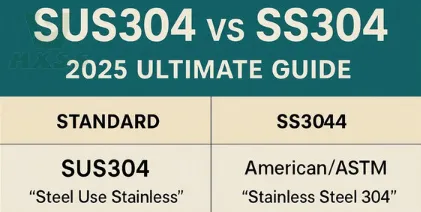
What is SUS304 Stainless Steel?
SUS304 stainless steel, also known as A2 or 18/8 stainless steel, is a standard 18% chromium/8% nickel stainless steel with a carbon content of ≤0.08%. It exhibits excellent corrosion resistance in general environments. It cannot be hardened by heat treatment and is typically used in the annealed condition. It is weldable and machinable and is commonly used in sinks, food storage tanks, surgical instruments, and exhaust systems.
What is SUS 304L Stainless Steel?
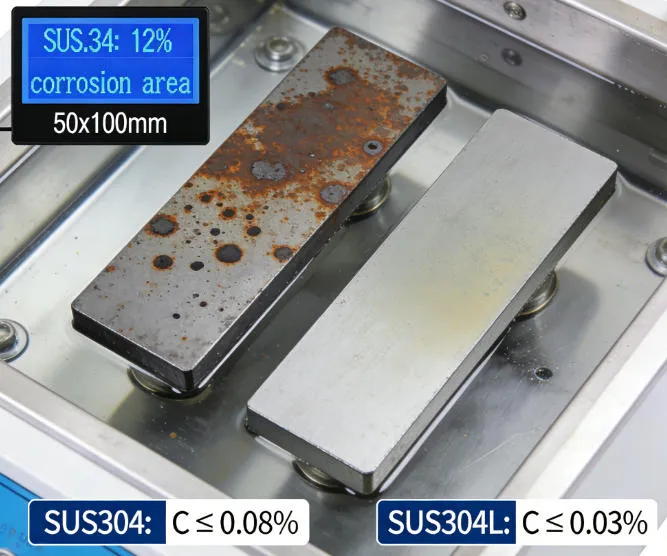
SUS304L stainless steel is a strong, silver-gray alloy, a low-carbon version with a carbon content of ≤0.03%, lower than 304 stainless steel. It is designed to minimize sensitization (precipitation of chromium carbides at grain boundaries during welding/heating), thus maintaining corrosion resistance in the welded area. It is primarily used in industries such as chemical processing, food and beverage manufacturing, and construction.
During welding or prolonged heating in the sensitization range (approx. 450–850 °C), carbon in SUS304 combines with chromium to form Cr₂₃C₆ at grain boundaries, depleting local Cr below the passive threshold (~12 %), leading to intergranular attack. SUS304L's ultra‑low carbon (<0.03 %) suppresses this reaction, preserving the Cr‑rich passive layer.

SUS304 vs SUS304L:Corrosion Resistance Deep Dive
|
|
|
|
|---|---|---|
|
|
|
|
|
|
|
|
|
|
|
|
|
|
|
|
|
|
|
|
SUS304 vs SUS304L: Key Differences
SUS304 vs SUS304L: Chemical Composition Comparison
|
|
|
|
|---|---|---|
|
|
|
|
|
|
|
|
|
|
|
|
|
|
|
|
|
|
|
|
|
|
|
|
|
|
|
|
|
|
|
|
SUS304 vs SUS304L: Mechanical Properties (Annealed Condition)
|
|
|
|
|---|---|---|
|
|
|
|
|
|
|
|
|
|
|
|
|
|
|
|
|
|
|
|
|
|
|
|
SUS304 vs SUS304L: Applications
|
|
|
|
|---|---|---|
|
|
|
|
|
|
|
|
|
|
|
|
|
|
|
|
|
|
|
|
Is SUS304L more expensive than SUS304?
Yes, typically 5–15 % higher per kg due to extra refining steps, but lower lifecycle cost in welded corrosive service.
Can I use SUS304 instead of SUS304L for welded structures?
Only if post‑weld solution annealing is performed; otherwise, risk of intergranular attack exists.
Which grade is better for pharmaceutical equipment?
SUS304L is preferred for fully welded assemblies to ensure cleanability and corrosion resistance.
SUS304 stianless steel suppliers
At GNEE, SUS304 is available in various forms to meet diverse industrial needs:
Plates and Sheets (cold rolled and hot rolled)
Bars and Rods (round, square, hexagonal)
Tubes (seamless and welded)
Wires and Strips (for springs, fasteners, electrical applications)
Forgings and Custom Parts (according to drawings or specifications)
Testing and Documentation: Mill Test Certificates, EN 10204 3.1, Chemical Reports, Mechanical Reports, Destructive Testing Reports, Non-Destructive Testing Reports, PMI Test Reports, Visual Inspection Reports, Third-Party Inspection Reports, NABL Certified Laboratory Reports.
Packaging: Wooden crates, bubble wrap, steel strapping, or packaged according to customer requirements.


Send Inquiry