







ASTM A213 TP316L vs. ASTM A249 TP316L: Heat Exchanger Tube
Jul 02, 2026
Leave a message
When purchasing TP316L stainless steel heat exchanger tubes, many buyers focus only on the material grade and overlook an equally important factor-the manufacturing standard. In reality, ASTM A213 TP316L and ASTM A249 TP316L are designed for different production processes and service conditions. Choosing the wrong specification may increase maintenance costs, shorten equipment life, or even cause unexpected downtime.
This guide compares the two standards from an engineering and procurement perspective, helping buyers select the most cost-effective solution for heat exchangers, condensers, boilers, and pressure equipment.
What is the difference between ASTM A249 and A213?
ASTM A249 is a standard specification for welded austenitic steel boiler, superheater, heat-exchanger, and condenser tubes. ASTM A213 is a standard specification for seamless ferritic and austenitic alloy-steel boiler, superheater, and heat-exchanger tubes.

What is ASTM A213 TP316L heat exchanger tube?
ASTM A213 TP316L heat exchanger tube is a premium seamless austenitic stainless steel tube containing 16–18% chromium, 10–14% nickel, and 2–3% molybdenum, engineered for demanding heat transfer applications. Utilizing a seamless process (hot-finished or cold-drawn) to withstand high pressures, it performs reliably under continuous service at temperatures up to 870°C (1,598°F). It is typically manufactured in outer diameter (OD) ranges from 1/8 inch to 5 inches, with wall thicknesses ranging from 0.015 inch to 0.500 inch.
What is ASTM A249 TP316L welded pipe for heat exchangers?
ASTM A249 TP316L refers to welded austenitic stainless steel tubes of grade TP316L manufactured in accordance with the ASTM A249 standard specification. These tubes are specifically designed for high-temperature and high-pressure service in equipment such as boilers, superheaters, heat exchangers, and condensers. It is the low-carbon version of Type 316 stainless steel, with a maximum carbon content of 0.035% engineered to prevent carbide precipitation during welding. Fabricated from stainless steel plate or strip, the tubes are formed and produced using automatic welding processes (such as TIG, plasma, or laser welding). The weld seam is typically cold-worked to ensure uniform strength, and the tubes undergo a solution heat treatment to maximize long-term durability.
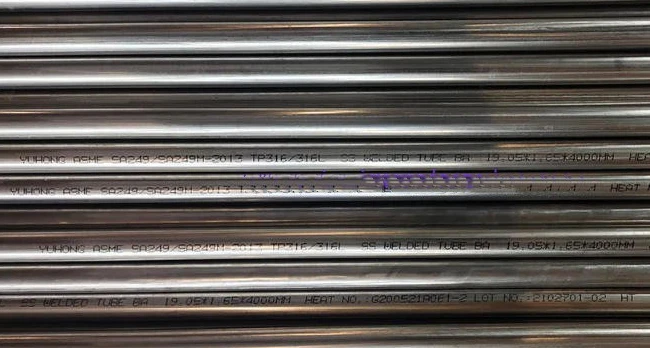
ASTM A213 TP316L vs. ASTM A249 TP316L: Heat Exchanger Tube
| Feature | ASTM A213 TP316L | ASTM A249 TP316L |
|---|---|---|
| Manufacturing Process | Seamless (extruded or cold-drawn, no weld seam) | Welded (formed from strip, TIG/PAW welded) |
| Weld Processing | N/A | Must be cold-worked after welding and before final heat treatment |
| Pressure Limits | Superior for extremely high-pressure systems | Suitable for moderate-to-high pressure |
| Cost | More expensive | More cost-effective |
| Common Uses | Boilers, superheaters, and extreme-duty heat exchangers | Condensers, feedwater heaters, and standard heat exchangers |
Chemical Composition Comparison (Weight %)
| Standard & Grade | C (max) | Mn (max) | P (max) | S (max) | Si (max) | Cr | Ni | Mo |
| ASTM A213 TP316L | 0.030 | 2.00 | 0.045 | 0.030 | 0.75 | 16.0 - 18.0 | 10.0 - 14.0 | 2.0 - 3.0 |
| ASTM A249 TP316L | 0.030 | 2.00 | 0.045 | 0.030 | 0.75 | 16.0 - 18.0 | 10.0 - 14.0 | 2.0 - 3.0 |
Note: The chemical requirements for TP316L are identical across both standards as they follow the same Grade 316L austenitic specification.
Mechanical Properties & Testing Comparison
| Property / Test | Unit | ASTM A213 TP316L (Seamless) | ASTM A249 TP316L (Welded) |
| Tensile Strength (min) | MPa [ksi] | 485 [70] | 485 [70] |
| Yield Strength (min) | MPa [ksi] | 170 [25] | 170 [25] |
| Elongation (min) | % in 2" | 35% | 35% |
| Hardness (max) | HRB [HBW] | 90 HRB [192 HBW] | 90 HRB [192 HBW] |
| Flattening Test | - | Required | Required (on both tube and weld) |
| Flaring Test | - | Required | Required |
| Flange Test | - | Optional (as per size) | Required |
| Reverse Flattening | - | Not Required | Mandatory (specifically for the weld) |
| Hydrostatic Test | - | Mandatory (unless NDT is used) | Mandatory (unless NDT is used) |
| Nondestructive Test | - | ET (Eddy Current) or UT (Ultrasonic) | ET (Eddy Current) is standard |
ASTM A213 TP316L vs. ASTM A249 TP316L: Wall Thickness Tolerance
A213: Typically specified as Minimum Wall (MW), ensuring the thickness is never less than ordered, which is critical for safety calculations in boilers.
A249: Typically specified as Average Wall (AW), which allows for a
±10% variation, making it easier to manufacture with high concentricity but requires careful consideration of pressure limits.
ASTM A213 TP316L vs. ASTM A249 TP316L: Pressure Rating
ASTM A213 TP316L tubing is manufactured using a seamless process; it features no longitudinal welds and a uniform microstructure, resulting in a joint efficiency factor of E = 1.00. In contrast, ASTM A249 TP316L tubing is produced via a welding process (typically electric resistance welding or electric fusion welding). Pressure calculations require the use of a standard joint efficiency factor (usually E = 0.85), resulting in a rated load-bearing capacity approximately 15% to 20% lower than that of seamless tubing of the same dimensions.
ASTM A213 TP316L vs. ASTM A249 TP316L: Corrosion Resistance
Both ASTM A213 TP316L and ASTM A249 TP316L utilize the same low-carbon 316L stainless steel alloy (UNS S31603), meaning their inherent corrosion resistance is essentially identical. However, because ASTM A213 TP316L stainless steel heat exchanger tubes are seamless, they feature a uniform metallurgical structure free of weld-related crevices. Conversely, the weld seams of ASTM A249 TP316L welded heat exchanger tubes have historically been more susceptible to localized corrosion. Consequently, ASTM A213 TP316L provides a longer service life under highly corrosive environments, high mechanical stress, or high-pressure operating conditions
ASTM A213 TP316L vs. ASTM A249 TP316L: How to Choose?
If your system involves critical, life-safety components operating under extreme temperatures and pressures (such as high-pressure boilers), please select tubing that meets the ASTM A213 standard. For condensers and standard shell-and-tube heat exchangers, ASTM A249 tubing is generally sufficient; however, many engineering designs mandate the use of seamless tubing to ensure reliability. Please consult your Piping and Instrumentation Diagram (P&ID) to verify whether the use of welded tubing (ASTM A249) is explicitly prohibited.
If you can provide more information about the application, I can help you determine the most suitable type of tubing: What are the operating pressure and temperature of the heat exchanger? Is the medium highly corrosive (e.g., acids or chlorides)? Is this a new project, or a tube bundle replacement (or re-tubing) project?
ASTM A213 TP316L Stainless Steel Tube Supplier, Manufacturer, Factory
Stock Availability:
We maintain a standing inventory of over 300 tonnes of standard-specification heat exchanger tubing:
19.05 mm x 1.65/2.11 mm (3/4")
25.4 mm x 1.65/2.11 mm (1")
Delivery lead time for stock items: 3–5 days (including inspection and marking).
Made-to-Order (MTO):
Standard orders: 20–30 days.
Custom U-bend orders: 35–45 days (including precision bending and stress-relief annealing).
Emergency Service: For unplanned refinery shutdowns, we offer a "Green Channel" service to prioritize production and ensure delivery within 15 days.
ASTM A213 TP316L / ASTM A249 TP316L Specifications
| Feature | ASTM A213 TP316L (Seamless) | ASTM A249 TP316L (Welded) |
| Manufacturing Process | Cold Drawn / Cold Rolled (Seamless) | Automatic Welding (ERW/TIG/Laser) |
| Available Forms | Straight Tubes, U-Bends, Coiled Tubes | Straight Tubes, U-Bends, Fin Tubes |
| Common Size (OD) | 6.35 mm – 127 mm (1/4" to 5") | 12.7 mm – 127 mm (1/2" to 5") |
| Wall Thickness | 0.89 mm – 12.7 mm (Minimum Wall) | 0.5 mm – 5.0 mm (Average Wall) |
| Length | Up to 25 meters (Single length) | Up to 30 meters |
| Surface Finish | Pickled & Annealed (AP) / Bright Annealed (BA) | Bright Annealed (BA) / Polished (Grit 180-600) |
| Ends Preparation | Plain, Beveled, or Square Cut | Plain, Beveled, or Square Cut |


Packaging & Logistics
To prevent sea-salt corrosion and physical damage during international transit:
Tube Ends: Sealed with high-quality plastic caps to prevent dust and moisture ingress.
Internal Protection: Each tube is separated by plastic films (for BA finish) to prevent scratches.
Outer Packing: Heavy-duty Fumigated Wooden Cases (compliant with IPPC standards) or reinforced steel-framed crates.
Documentation: A waterproof pouch containing the MTC (EN 10204 3.1), Packing List, and Quality Photos is attached to each crate.


Send Inquiry