







What is the difference between EN 1.4410 and 316 stainless steel?
May 09, 2026
Leave a message
What are the material properties of 1.4410?
1.4410 (also known as Super Duplex Stainless Steel, UNS S32750, F53, or Alloy 2507) is a highly alloyed super duplex stainless steel featuring a chromium content of up to 25%. It exhibits exceptional resistance to chloride-induced stress corrosion cracking, pitting, and crevice corrosion. Possessing extremely high mechanical strength (yield strength > 550 MPa) and excellent toughness, this material is specifically designed for use in harsh, high-temperature, or seawater environments.
What are the properties of 316 stainless steel?
Grade 316 stainless steel is a versatile austenitic "marine-grade" alloy. Its composition comprising 16–18% chromium, 10–14% nickel, and 2–3% molybdenum confers exceptional corrosion resistance against chlorides, acids, and harsh environments. This alloy combines excellent strength, toughness, and high-temperature stability, and offers superior resistance to pitting and crevice corrosion compared to Grade 304 stainless steel.
1.4410 vs. 316 Stainless Steel: Key Differences
1.4410 vs. 316 Stainless Steel: Equivalent Materials
| Feature | 1.4410 (Super Duplex) | 316 (Standard Austenitic) |
| UNS Number | S32750 | S31600 (S31603 for 316L) |
| EN Designation | 1.4410 / X2CrNiMoN25-7-4 | 1.4401 / X5CrNiMo17-12-2 |
| Microstructure | Ferritic-Austenitic (50/50 balance) | Fully Austenitic |
| Magnetic State | Ferromagnetic (Magnetic) | Paramagnetic (Non-Magnetic) |
1.4410 vs. 316 Stainless Steel:Chemical Composition (wt. %)
Typical values according to EN 10088.
| Element | 1.4410 (S32750) | 316 (S31600) |
| Chromium (Cr) | 24.0 – 26.0 | 16.5 – 18.5 |
| Nickel (Ni) | 6.0 – 8.0 | 10.0 – 13.0 |
| Molybdenum (Mo) | 3.0 – 4.5 | 2.0 – 2.5 |
| Nitrogen (N) | 0.24 – 0.35 | ≤ 0.10 |
| Carbon (C) | ≤ 0.030 | ≤ 0.070 (0.030 for 316L) |
1.4410 vs. 316 Stainless Steel:Mechanical Properties
Typical values at room temperature (Solution Annealed).
| Property | 1.4410 (Super Duplex) | 316 (Austenitic) |
| Yield Strength (Rp0.2) | ≥ 550 MPa | ~ 200 - 220 MPa |
| Tensile Strength (Rm) | 800 – 1000 MPa | 500 – 700 MPa |
| Elongation (A5) | ≥ 25 % | ≥ 40 % |
| Hardness (Brinell) | ~ 290 HBW | ~ 150 - 170 HBW |
1.4410 vs. 316 stainless steel: Corrosion Resistance
1.4410 (Super Duplex) significantly outperforms 316 stainless steel in corrosionresistance, particularly in harsh, chloride-rich environments like marine applications anchemical processing. With a Pitting Resistance Equivalent Number (PREN) > 40, 1.441offers superior protection against pitting, crevice corrosion, and stress corrosion crackincompared to the 23-25 PREN of 316.
Are 1.4410 and 316 magnetic?
1.4410 contains approximately 50% ferrite and is therefore strongly magnetic. 316 possesses a purely austenitic structure and is typically non-magnetic.
Are machining and welding more difficult for 1.4410 than for 316?
1.4410 exhibits higher strength and undergoes more severe work hardening, placing greater demands on cutting tools. During welding, heat input must be strictly controlled to maintain phase balance, making the process more complex than that of 316.
1.4410 vs. 316 stainless steel: Applications
316 Stainless Steel: Suitable for moderately corrosive environments, such as food processing, pharmaceutical equipment, building facades, general chemical vessels, and mild marine environments.
1.4410 Stainless Steel: Specifically designed for extremely demanding corrosive and mechanical environments; its applications include:
Oil & Gas: Offshore platforms (heat exchangers, water treatment systems), subsea pipelines.
Chemical & Petrochemical: Equipment handling highly corrosive media, flue gas (and waste gas) purification systems.
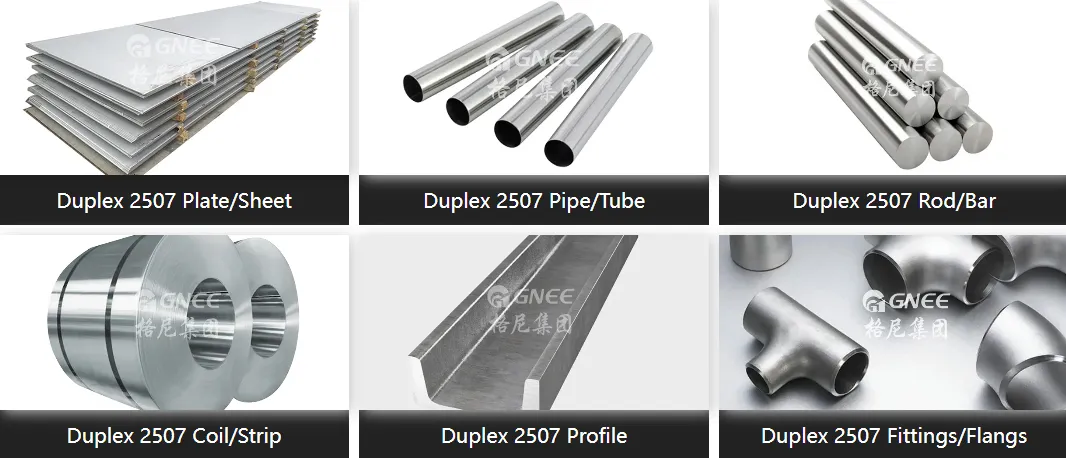
If you have project-specific requirements for 2507 (1.4410) stainless steel, we invite you to place an order. GNEE maintains an extensive inventory of popular products for you to choose from. This material can be processed into a wide variety of practical forms-including plates, coils, tubes, bars, wires, and more. For detailed chemical composition data or to request free samples, please contact our facility immediately. We offer competitive pricing and exceptional service.Email: sales@gneestainless.com
Send Inquiry