

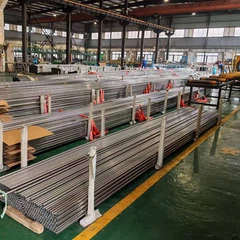
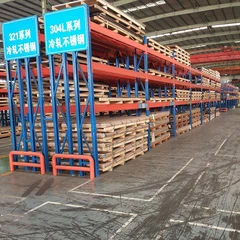
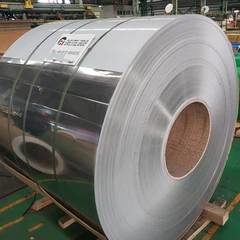
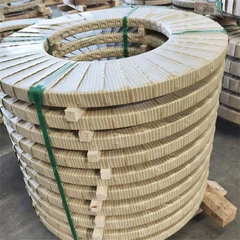
316L Bright Annealed Stainless Steel Pipe Applications
Jul 16, 2025
Leave a message
Why Bright Annealing Changes the Performance of 316L Pipe
316L (UNS S31603) is the low-carbon, molybdenum-bearing austenitic grade with roughly 16-18% chromium, 10-14% nickel and 2.00-3.00% molybdenum. Bright annealing is carried out in a vacuum or in a high-purity hydrogen or inert gas atmosphere, so the tube leaves the furnace free of the oxide scale and pickling residue that normally accompanies mill annealing. The result is a mirror-bright, chemically passive surface that is also smoother, harder to wet and far easier to clean than a conventional annealed and pickled tube.
Two consequences follow from that surface. First, internal cleanliness: because there is no oxide layer, there is no flaking debris to shed into a process stream, which is what ultra-high-purity gas and pharmaceutical water systems demand. Second, corrosion performance: a uniform, undisturbed passive film resists intergranular attack and crevice corrosion better than a mechanically descaled surface, and there are no residual pickling acids trapped in the bore.
| Property | Typical value for 316L in the annealed condition |
|---|---|
| Tensile strength (min) | 485 MPa (70 ksi) |
| 0.2% offset yield strength (min) | 170 MPa (25 ksi) |
| Elongation (min) | 35% |
| Hardness (max) | 90 HRB |
| Carbon content (max) | 0.035% |
| Typical bright annealed bore finish | Ra 0.4-0.8 µm |
Food and Beverage Processing
Beverage production lines, dairy pipelines, brewery vessels, cooking and cooling circuits and aseptic filling systems all rely on hygienic tubing that can be cleaned in place and steam sterilized without attacking the surface. The non-porous bright bore removes the crevices where bacteria and product residues collect, and the grade tolerates the acid, alkali and additive chemistry of food plants as well as repeated CIP and SIP cycles. Tubing for these duties is normally supplied to ASTM A270 or 3-A sanitary finish requirements, with FDA-compliant surfaces and documented weld quality on orbital joints.
Milk, yoghurt and dairy product transfer lines
Brewing and fermentation piping, including CIP supply and return
Carbonated soft drink and juice blending circuits
Aseptic filling heads and filler supply manifolds
Pharmaceutical and Medical Gas Systems
Purified water, water for injection, clean steam and medical gas distribution demand a bore that does not shed particles and does not harbour biofilm. Bright annealed 316L tube with an internal finish of Ra 0.8 µm or better, and often considerably smoother after electropolishing, is the standard material selection for these systems. The low carbon content keeps the weld heat affected zone free of chromium carbide precipitation, so orbital welds can be made without a post-weld solution anneal, and the molybdenum addition gives the chloride tolerance needed for saline and other electrolyte-bearing media.
Typical duties include oxygen and nitrous oxide delivery pipelines, WFI and purified water loops, sterile liquid drug transfer lines and structural components of medical equipment. Design and documentation usually follow ASME BPE in addition to the applicable ASTM tube specification.
Semiconductor and Ultra-High-Purity Gas Lines
Semiconductor fabs require gas and water delivery that contributes essentially no contamination. Silane, ammonia, nitrogen and other process gases, plus deionized water and clean-room vacuum lines, are carried in bright annealed 316L tube with an internal roughness of Ra 0.4 µm or finer. Because annealing is performed under vacuum or inert gas, the bore is free of oxide that would otherwise release metal ions and particles into the process stream. Tubes are supplied with capped ends, cleaned to ultra-high-purity practice and handled under clean-room conditions up to the point of orbital welding.
Aerospace, Cryogenic and Chemical Transport Duties
In aircraft fuel and hydraulic systems and in spacecraft cryogenic service, 316L tube is chosen for the balance of strength and toughness it retains after annealing, which allows it to survive high pressure, vibration and extreme temperature excursions from deep cryogenic levels to elevated service temperatures. The optimized strength-to-weight ratio supports lightweight design without sacrificing burst margin. In chemical transport, the same material handles aggressive acid and alkali media, seawater desalination equipment, offshore platform piping and reactor connection lines, where the uniform passive film limits product deposition, reduces blockage and extends service life.
A parallel family of surface finishes is available for decorative and light-duty duties, including mirror polished, brushed, honed, sandblasted, frosted and 2B polished tube for commercial kitchen exhaust, hotel architectural pipework and food display structures, where appearance and cleanability matter as much as corrosion resistance.
Frequently Asked Questions
Q: What is the difference between bright annealed and pickled 316L tube?
Bright annealing takes place in a vacuum or inert atmosphere, so no oxide forms and no acid pickling is needed afterwards. The bore stays bright and smooth, whereas pickled tube has a matte, chemically descaled surface.
Q: Which surface roughness can be guaranteed?
Standard bright annealed pharmaceutical tubing is typically supplied at Ra 0.8 µm or better, and semiconductor-grade tube is normally specified at Ra 0.4 µm or finer. The exact limit must be stated on the purchase order because it is verified by sampling.
Q: Why is the low carbon content of 316L important?
With carbon held to 0.035% maximum, chromium carbide precipitation in the weld heat affected zone is suppressed, so intergranular corrosion resistance survives welding without a post-weld solution anneal.
Q: Which standards apply to 316L bright annealed tube?
ASTM A269 and ASTM A270 cover seamless and welded austenitic tube, ASME BPE covers bioprocessing systems, and EN 10216-5 and ISO 1127 are commonly used where European dimensional practice applies.
Q: Can bright annealed 316L tube be used at cryogenic temperature?
Yes. The annealed austenitic structure stays ductile at deep cryogenic levels, which is why the grade is used for liquid oxygen and liquid hydrogen transfer lines. Low-temperature impact and hardness limits must still be agreed with the supplier for each order.
Q: Does bright annealing affect the mechanical properties?
The anneal restores the soft, fully austenitic condition, so strength is lower than a cold-worked tube but toughness and corrosion resistance are higher. Typical values are 485 MPa minimum tensile strength and 170 MPa minimum 0.2% yield strength.
Send Inquiry