

316 Stainless Steel Pipe and Tube: Molybdenum-Enhanced Chloride-Resistant Piping
Jan 30, 2026
Leave a message
What Is 316 Stainless Steel Pipe and Tube?
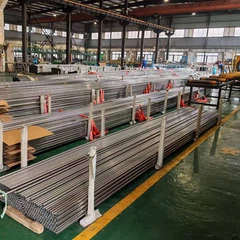
316 stainless steel pipe and tube are austenitic products containing 2.00 to 3.00 percent molybdenum, an addition that sharply improves resistance to pitting and crevice corrosion from chloride ions compared with 304. This makes 316 piping the standard specification for coastal, marine and weakly corrosive industrial service, including chemical processing, food and beverage lines and coastal architecture. Products are made seamless or welded, and are covered by ASTM A312 for seamless and welded pipe, A358 for large-diameter welded pipe, A213 for seamless boiler and heat-exchanger tubes, A269 for small-diameter tubing, and A999 for dimensional tolerances. European equivalents are EN 1.4401 and 1.4404, and the Japanese equivalent is JIS SUS316/SUS316L.
Chemical Composition of 316, 316L and 316H
The three grades share chromium, nickel and molybdenum ranges but differ in carbon control. 316L limits carbon to avoid sensitisation during welding; 316H holds carbon between 0.04 and 0.10 percent to retain creep strength at elevated temperature.
| Element | 316 S31600 | 316L S31603 | 316H S31609 |
|---|---|---|---|
| Carbon, max | 0.08 | 0.030 | 0.04-0.10 |
| Manganese, max | 2.00 | 2.00 | 2.00 |
| Phosphorus, max | 0.045 | 0.045 | 0.045 |
| Sulfur, max | 0.030 | 0.030 | 0.030 |
| Silicon, max | 0.75 | 0.75 | 0.75 |
| Chromium | 16.0-18.0 | 16.0-18.0 | 16.0-18.0 |
| Nickel | 10.0-14.0 | 10.0-14.0 | 10.0-14.0 |
| Molybdenum | 2.0-3.0 | 2.0-3.0 | 2.0-3.0 |
| Nitrogen, max | 0.10 | 0.10 | - |
Mechanical Properties and Key Characteristics
Annealed mechanical requirements for the pipe grades follow ASTM A312. Density is 7.98 g/cm3 and the melting range is approximately 1375 to 1450 degrees C.
| Property | 316 / 316H | 316L |
|---|---|---|
| Tensile strength, min | 515 MPa | 485 MPa |
| Yield strength, min | 205 MPa | 170 MPa |
| Elongation, min | 40 percent | 40 percent |
| Hardness, max | 217 HBW | 217 HBW |
Key characteristics include molybdenum-boosted resistance to pitting and crevice attack, excellent formability and weldability for complex piping layouts, stable mechanical properties through the medium-temperature range for process piping, and broad adaptability across marine, chemical and coastal building applications. The pitting resistance equivalent number, Cr + 3.3Mo + 16N, is about 24 at minimum composition, compared with roughly 19 for 304.
Applicable Product Standards and Dimensions
ASTM A312 covers seamless and straight-seam welded pipe in 316, 316L and 316H in standard schedules from small-bore to large diameters, with wall thicknesses matched to nominal pipe sizes per ASME B36.19. ASTM A213 covers seamless boiler, superheater and heat-exchanger tubes, which are typically supplied to tighter dimensional tolerances. ASTM A269 covers small-diameter seamless and welded tubing for general, low- and medium-pressure service. Seamless product is commonly available from 6 to 650 mm outside diameter with walls from 0.5 to 50 mm; welded pipe extends to about 3000 mm outside diameter with walls from 1 to 150 mm. Dimensional tolerances are verified to ASTM A999.
Typical Applications
Marine engineering and coastal process piping
Chemical and petrochemical transfer lines
Heat exchangers, condensers and boiler auxiliaries
Food, beverage and pharmaceutical process lines
Seawater and brackish-water systems at ambient temperature
Architectural handrails and structural tubing in chloride atmospheres
Frequently Asked Questions
Q: How does molybdenum improve 316 pipe? Molybdenum strengthens the passive film and raises pitting and crevice corrosion resistance in chloride media, which 304 lacks entirely.
Q: When should 316L pipe be specified? For welded systems, especially heavy-wall pipe, 316L avoids chromium-carbide precipitation in the heat-affected zone, so no post-weld solution annealing is needed in most services.
Q: What is 316H used for? 316H retains higher creep strength at elevated temperature and is specified for pressure-containing piping and tubing above about 525 degrees C.
Q: Seamless or welded 316 pipe? Seamless pipe suits high-pressure and small-diameter service; welded pipe is economical for large diameters. Both are accepted by ASTM A312 when manufactured to its requirements.
Q: Is 316 pipe suitable for seawater? For ambient-temperature, flowing seawater it performs well, but stagnant seawater in crevices can cause localised attack; duplex or super-austenitic grades are used for permanent immersion.
Q: Which standards govern 316 pipe? ASTM A312 for pipe, A358 for large-diameter welded pipe, A213 for boiler and heat-exchanger tubes, A269 for small-diameter tubing, and A999 for tolerances; European equivalents follow EN 10216-5 and EN 10217-7.
Frequently Asked Questions
Q1. What grades does ASTM A312 define for 316 piping?
ASTM A312 covers 316 (UNS S31600) with carbon 0.08 max, low-carbon 316L (UNS S31603) with 0.030 max, and high-carbon 316H (UNS S31609) with 0.04-0.10 percent for elevated-temperature strength; all share chromium 16.0-18.0, nickel 10.0-14.0 and molybdenum 2.0-3.0.
Q2. What are the annealed mechanical requirements?
Per ASTM A312, 316 and 316H show minimum tensile strength 515 MPa and yield strength 205 MPa, while 316L shows 485 MPa and 170 MPa; elongation is 40 percent minimum for all, density is 7.98 g/cm3 and the melting range is approximately 1375 to 1450 degrees C.
Q3. What dimensions can 316 pipe and tube be supplied in?
Seamless product is commonly available from 6 to 650 mm outside diameter with walls from 0.5 to 50 mm, while welded pipe extends to about 3000 mm outside diameter with walls from 1 to 150 mm; wall thicknesses are matched to nominal pipe sizes per ASME B36.19 and dimensional tolerances are verified to ASTM A999.
Q4. What are the European and Japanese equivalents of 316?
The European equivalents are EN 1.4401 and 1.4404, and the Japanese equivalent is JIS SUS316/SUS316L; related product standards include ASTM A358 for large-diameter welded pipe, A213 for seamless boiler and heat-exchanger tubes, and A269 for small-diameter tubing.
Q5. What is the PREN of 316 and where is it used?
The pitting resistance equivalent number, Cr + 3.3Mo + 16N, is about 24 at minimum composition compared with roughly 19 for 304, which is why 316 piping is specified for marine engineering, chemical and petrochemical transfer lines, heat exchangers, food and pharmaceutical process lines, and seawater systems at ambient temperature.
Send Inquiry