

904L Tubing for Chemical Processing: Acid and Chloride Service
May 20, 2025
Leave a message
Why 904L Tubing Suits Chemical Processing
Chemical plants handle sulfuric acid, phosphoric acid, hydrochloric acid and chloride-bearing process streams at temperatures where ordinary austenitic stainless steels become unreliable. 904L tubing, UNS N08904 and EN 1.4539, was developed precisely for this environment. Its high nickel and copper content allows it to resist reducing acids that attack 316L quickly, while its molybdenum and chromium content maintains resistance to pitting and crevice corrosion in chloride-bearing solutions.
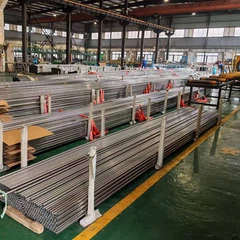
Tubing is the most exposed form of the material: walls are thin, both surfaces are in contact with the process, and a single through-wall penetration ends a production campaign. That is why heat exchangers, condensers, sampling lines and acid transfer circuits in chemical plants are routinely specified in this grade.
Chemistry and Corrosion Performance
The alloy contains about 20% chromium, 25% nickel, 4.5% molybdenum and 1.5% copper, with carbon limited to 0.020% so that welding does not sensitise the material. The combination produces a high pitting resistance equivalent number, above 34, and gives the grade its wide-spectrum corrosion behaviour.
Sulfuric acid: good resistance across a broad range of concentration and temperature, including the dilute and the concentrated zones where 316L fails
Phosphoric acid: suitable for wet-process streams containing chlorides and fluorides
Hydrochloric acid: usable in dilute, low-temperature streams, though highly concentrated hot hydrochloric acid remains outside the grade's practical range
Chloride pitting and crevice corrosion: significantly better than 316L and 317L thanks to molybdenum and nitrogen
Stress corrosion cracking: resistant in chloride service where standard austenitic grades crack
Because copper additions promote passivity in reducing acids, the grade is often selected where a single line carries a mixture of acids, chlorides and occasional oxidising agents.
Standards and Specifications for 904L Tubing
| Item | Value |
|---|---|
| UNS number | N08904 |
| European designation | 1.4539, X1NiCrMoCu25-20-5 |
| Seamless tube standard | ASTM B677 / ASME SB-677, EN 10216-5 |
| Welded tube standard | ASTM B674 / ASME SB-674, EN 10217-7 |
| Welded pipe standard | ASTM B673 / ASME SB-673 |
| Flat product input | ASTM B625, EN 10088-2 |
| Delivery condition | Solution annealed, bright annealed or pickled |
| Forms | Straight lengths or U-bend, seamless or welded |
Dimensionally, tubes follow ASME B36.19M outside diameters and wall schedules for the American route and the EN 10216-5 tolerance tables for the European route. U-bend tubing for shell and tube exchangers is supplied with controlled ovality and stress relief requirements agreed with the fabricator.
904L Compared with Other Austenitic Grades
The table gives a qualitative ranking for the duties that dominate chemical processing, with the alternative of duplex grade 2205 shown for reference.
| Grade | Pitting resistance | Sulfuric acid resistance | Yield strength | Relative cost |
|---|---|---|---|---|
| 316L | Moderate | Poor | Standard | Low |
| 317L | Good | Fair | Standard | Medium |
| 904L | Excellent | Excellent | Standard | High |
| Duplex 2205 | Excellent | Moderate | Roughly double | Medium to high |
Duplex 2205 offers higher strength and good chloride performance, but its resistance to reducing acids is lower because it contains no copper. Where a mixed acid environment dominates, 904L is the more dependable choice; where high pressure and chloride cracking dominate, duplex is often more economical.
Fabrication and Quality Control
Bending and forming: higher work-hardening rate than 316L, so generous bend radii and intermediate annealing are used for tight geometry
Welding: over-alloyed filler matching the AWS ER385 classification, low heat input, full argon purge and low interpass temperature
Post-weld treatment: pickling, brushing or electropolishing to remove heat tint before the tube enters service
Testing: hydrostatic or eddy current testing as standard, plus flattening, flaring and reverse bend tests on samples
Certification: EN 10204 3.1 mill test certificate listing heat number, analysis, mechanical results and the referenced standard
Cleanliness: tubes degreased and capped for condensers and other units where residual contamination would seed corrosion
Together these measures keep the corrosion resistance of the finished assembly close to that of the parent metal, which is the property the plant actually relies on after installation.
Frequently Asked Questions
Q: Why is 904L tubing preferred over 316L in chemical plants?
Because 316L is attacked by hot or concentrated sulfuric and phosphoric acid and suffers chloride pitting, while 904L resists these media. It also resists chloride stress corrosion cracking, which removes a common cause of tube failure.
Q: Is 904L tubing available in both seamless and welded form?
Yes. Seamless tube is made to ASTM B677 and welded tube to ASTM B674, with EN 10216-5 and EN 10217-7 covering European requirements. Welded tube is solution annealed after welding to restore full corrosion resistance.
Q: Can 904L tubing handle hydrochloric acid?
In dilute, low-temperature streams yes, and that is a common application. Hot, concentrated hydrochloric acid is beyond the practical limit of any standard austenitic grade and requires a different alloy family.
Q: What wall thickness is used for sulfuric acid coolers?
Wall thickness is set by the mechanical and thermal design of the exchanger rather than by a corrosion allowance, since the alloy does not rely on thickness for corrosion resistance. Typical tubes follow standard schedules with minimum walls around 1 mm for smaller diameters.
Q: Does 904L tubing require special cleaning before welding?
Yes. The joint area must be free of oil, grease, marking ink and chloride contamination, and the bore should be argon purged so that no oxide scale forms on the inside surface.
Q: How is 904L tubing tested before delivery?
Standard testing includes chemical analysis, tensile and flattening tests, hydrostatic or eddy current examination and dimensional inspection, with intergranular corrosion testing added when the purchase order requires it.
Send Inquiry