

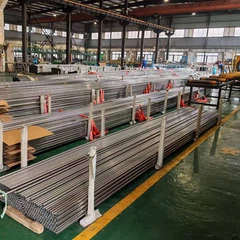
ASTM A376/A376M Seamless Austenitic Steel Pipe for High-Temperature Service
Jul 30, 2025
Leave a message
What ASTM A376/A376M Covers
ASTM A376/A376M is the standard specification for seamless austenitic steel pipe for high-temperature central-station service. In practice it covers the seamless pipe used in superheater and reheater tubing, main steam lines, steam headers and steam-gathering piping in fossil-fuel power stations, and in high-temperature process piping where oxidation resistance, creep strength and dimensional stability are all required at the same time. The "-02a" suffix in the title identifies a dated edition of the specification; projects should always work to the edition referenced in the purchase order.
The specification allows pipe to be hot finished or cold finished at the manufacturer's option, followed by a suitable finishing treatment and the required heat treatment. Because the service is high-temperature steam, the specification concentrates on three things: chemistry, solution heat treatment, and ultrasonic or hydrostatic testing to guarantee a sound sound seamless product.
Grades and Chemical Composition
ASTM A376/A376M covers five H grades together with nitrogen-bearing grades, and the chemical composition of each grade within the specification determines the exact percentages of chromium, nickel and other elements. In general, all the grades are austenitic stainless steels, meaning high chromium and nickel contents maintain the austenitic structure at operating temperature while providing oxidation and corrosion resistance.
| Grade | Carbon | Chromium | Nickel | Other |
|---|---|---|---|---|
| TP304H | 0.04-0.10% | 18.0-20.0% | 8.0-11.0% | Manganese 2.00% max |
| TP316H | 0.04-0.10% | 16.0-18.0% | 11.0-14.0% | Molybdenum 2.00-3.00% |
| TP321H | 0.04-0.10% | 17.0-19.0% | 9.0-12.0% | Titanium 4 x carbon min |
| TP347H | 0.04-0.10% | 17.0-19.0% | 9.0-13.0% | Niobium plus tantalum 8 x carbon min, 1.00% max |
| 16-8-2H | 0.05-0.10% | 14.5-16.5% | 7.5-9.5% | Molybdenum 1.50-2.00% |
The higher carbon ranges of the H grades are deliberate. Carbon is what gives these grades their improved creep and stress-rupture strength at 550 C and above, which is the main reason A376 pipe is specified for main steam and reheater duty rather than the lower-carbon grades of ASTM A312. The nitrogen-bearing grades achieve additional strength through nitrogen in solid solution. Titanium in TP321H and niobium plus tantalum in TP347H stabilise the carbon as carbide, which is what protects the material against intergranular corrosion after service exposure in the sensitising range.
Mechanical Properties and Yield Strength
The yield strength of A376/A376M pipe depends on the specific grade and temper. In the annealed and heat-treated condition the H grades are specified with a minimum yield strength of 205 MPa (30,000 psi) and a minimum tensile strength of 515 MPa (75,000 psi), while ductility remains high with a minimum elongation of 35% in 50 mm.
| Grade | Minimum Yield Strength | Minimum Tensile Strength | Typical Application |
|---|---|---|---|
| TP304H | 205 MPa (30,000 psi) | 515 MPa (75,000 psi) | Superheater tubing, steam piping |
| TP316H | 205 MPa (30,000 psi) | 515 MPa (75,000 psi) | Steam lines with higher corrosion demand |
| TP321H | 205 MPa (30,000 psi) | 515 MPa (75,000 psi) | Stabilised tubing for elevated temperature |
| TP347H | 205 MPa (30,000 psi) | 515 MPa (75,000 psi) | High-temperature headers and tubing |
For severe creep duty, higher-strength versions of the H grades are also available with a minimum tensile strength of about 550 MPa and a minimum yield strength of about 240 MPa. The limiting design property in central-station service is seldom tensile strength at room temperature; it is the stress-rupture and creep behaviour at the metal temperature, which is why wall thickness is usually set by the design code using elevated-temperature allowable stresses.
Heat Treatment Requirements
All pipe is delivered in the heat-treated condition unless the order states otherwise. If a final heat treatment is not included in the order, each pipe is stamped "HT-O". The main requirements are as follows.
Standard austenitic grades including TP304, TP304N, TP304LN, TP316, TP316N, TP316LN, TP321, TP347, TP348, 16-8-2H and S31725: heat to a minimum of 1,040 C (1,900 F) and quench in water or rapidly cool by other means.
Cold-worked H grades: minimum solution treatment of 1,100 C (2,000 F) for TP321H and TP347H, 1,040 C (1,900 F) for TP304H and TP316H, and 980 C (1,800 F) for 16-8-2H.
Hot-rolled H grades: minimum solution treatment of 1,050 C (1,925 F) for TP321H and TP347H, 1,040 C (1,900 F) for TP304H and TP316H, and 980 C (1,800 F) for 16-8-2H.
Intergranular corrosion caution: solution annealing above 1,065 C (1,950 F) may reduce the intergranular corrosion resistance of TP321, TP321H, TP347, TP347H, TP348 and TP348H after later exposure to sensitising conditions. Where this risk applies, a low-temperature stabilisation anneal or a re-solution anneal is performed after the high-temperature solution anneal.
Marking: if the final heat treatment temperature is less than 1,040 C (1,900 F), each pipe is marked with the actual final heat treatment temperature in degrees Fahrenheit or Celsius after the suffix "HT".
Cooling rate is as important as temperature. Rapid quenching from the solution annealing temperature keeps carbides in solution and produces the soft, fully austenitic structure needed for both corrosion resistance and subsequent fabrication.
Grain Size, Fabrication and Ordering Practice
The grain size of grades 304H, 316H, 321H and 347H is specified as grade 7 or coarser, determined in accordance with Test Method E112. A coarser grain structure improves creep strength at high temperature, and it is one of the checks a purchaser should require on the mill certificate for central-station pipe.
Fabrication is straightforward for an austenitic seamless product. Pipes may be hot finished or cold finished at the manufacturer's option, with the appropriate finishing treatment and a clean, scale-free surface. Bending, swaging of tube ends and welding are all routine, but two rules should be observed: use matching austenitic filler metals for welding, and avoid excessive heat input in order to preserve the grain size and the stabilised carbide structure achieved by heat treatment. On receipt, the pipe should be checked for grade markings, heat number traceability, heat treatment temperature marking, dimensional conformity and the required non-destructive or hydrostatic test certificate.
Frequently Asked Questions
Q: What is ASTM A376 material?
ASTM A376/A376M covers seamless austenitic steel pipe for high-temperature central-station service, including the five H grades and the nitrogen-bearing grades used in superheaters, reheaters, main steam lines and steam headers.
Q: What is the difference between A376 and A312 pipe?
Both are seamless austenitic specifications, but A376 is written for elevated-temperature central-station service and emphasises the higher-carbon H grades and their heat treatment, while A312 is a general-purpose corrosion-resistant piping specification.
Q: What is the yield strength of A376/A376M stainless steel pipe?
For the H grades in the heat-treated condition the minimum yield strength is 205 MPa (30,000 psi) with a minimum tensile strength of 515 MPa (75,000 psi) and minimum elongation of 35%. Higher-strength versions are available with about 240 MPa minimum yield and 550 MPa minimum tensile strength.
Q: What heat treatment does A376 require?
Unless the order states otherwise, pipe is heat treated by heating to a minimum of 1,040 C (1,900 F) and quenching or rapidly cooling. Cold-worked TP321H and TP347H require a minimum of 1,100 C (2,000 F), and 16-8-2H a minimum of 980 C (1,800 F).
Q: Why is grain size specified for A376 pipe?
Grades 304H, 316H, 321H and 347H must be grain size 7 or coarser per Test Method E112, because a coarse grain structure improves creep and stress-rupture strength at high steam temperature.
Q: What does the HT marking on A376 pipe mean?
Pipes that are not given a final heat treatment under the order are stamped "HT-O", while pipe heat treated below 1,040 C (1,900 F) is marked with the actual final heat treatment temperature after the suffix "HT".
Send Inquiry