

Biopharmaceutical Tubing: Electropolished 316L vs UNS N10276 Nickel Alloy
Jun 24, 2025
Leave a message
Why 316L-EP Tubing Dominates Buffer and Media Lines
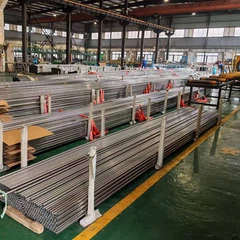
Electropolished 316L tubing (EN 1.4404, UNS S31603) is the default choice for buffer preparation, media hold and general product-contact lines in biopharmaceutical plants. Electropolishing removes the mechanically disturbed surface layer left by drawing and finishing, lowering roughness to about Ra 0.15-0.25 µm and reducing the total surface area available for particle retention and biofilm attachment.
Three properties drive the specification. First, the low carbon content of 316L limits chromium-carbide precipitation during welding, so intergranular corrosion resistance survives orbital GTAW. Second, the electropolished surface sheds particles: a well-controlled electropolished line typically releases fewer than five particles per cubic foot above 0.1 µm in flush testing. Third, the grade has decades of validation history behind it, including repeated steam-in-place cycles at 130 °C.
Tube standards: ASTM A270 for sanitary tubing, ASTM A269 for general austenitic tube.
Design code: ASME BPE, which sets dimensional, finish and documentation requirements for bioprocessing equipment.
Typical electropolished finish target: Ra ≤ 0.25 µm (10 µin) on product contact surfaces.
When Nickel-Molybdenum Alloy Tubing Becomes Mandatory
Tubing made from UNS N10276, a nickel-molybdenum-chromium alloy, is specified where 316L will not survive the chemistry of the process. The alloy typically contains 15-17% molybdenum with 14.5-16.5% chromium and balance nickel, which is what gives it resistance to pitting and crevice corrosion in high-chloride and strongly reducing acid environments.
Typical triggers for the upgrade:
High-purity mineral acids, in particular hydrochloric and nitric acid duties, and acid handling after dilution.
Cytotoxic drug handling, where containment and cleanability requirements are extreme.
Processes where chloride residues concentrate on the tube wall during evaporation or drying.
Oxidising and reducing duty cycles in the same line, which defeat the passive film on austenitic stainless steel.
Alloy tubing in this class is normally purchased to ASTM B622 for seamless tube and ASTM B626 for welded tube, with the corresponding UNS number stated on the certificate so that no proprietary grade name is needed for procurement.
Contaminant Limits in Purified Process Contact
Alloy selection only solves half the problem. The acceptance criteria for a finished line are analytical, and both 316L-EP and N10276 tubing are held to the same limits:
| Parameter | Typical limit | Test basis |
|---|---|---|
| Bacterial endotoxin | < 0.25 EU/mL | USP <85> bacterial endotoxins |
| Total organic carbon | < 500 ppb | USP <643> TOC |
| Metallic ions (Fe, Cr, Ni) | < 0.1 ppb each | ICP-MS on flush water |
| Particles above 0.2 µm | < 1 per mL | USP <788> particulate matter |
| Surface iron content | < 0.01% | Surface chemistry analysis after passivation |
| Surface roughness | Ra ≤ 0.25 µm, electropolished | Profilometry per ASME BPE |
Welding and Assembly Best Practices
Product-contact welds are the most likely source of both corrosion and contamination. The accepted practice for both grades is automatic orbital GTAW with fully documented parameters:
Filler metal: ER316L to AWS A5.9 for 316L tubing; a matching nickel-alloy filler for UNS N10276 tube.
Internal purge with high-purity argon, with oxygen held below 20 ppm to prevent heat-tint oxides.
Weld reinforcement limited to less than 10% of wall thickness; the bore must be smooth and flush, with no crevices.
Post-weld electropolishing of all product contact zones, followed by passivation to ASTM A967.
Bore inspection with borescope and documented colour acceptance criteria for the heat-tint band.
Qualification Testing Sequence and Cost Logic
A new line is qualified by test, not by certificate. A representative sequence covers adhesion, cleanliness and biological challenge: bovine serum albumin adhesion testing with a target below 5 µg/cm², USP <788> particulate testing on flush samples, HPLC analysis for extractables from the elastomer and tubing surfaces, and a bacterial biofilm challenge such as Pseudomonas aeruginosa.
Cost is the reason 316L-EP remains the default wherever chemistry permits. Indicative tubing costs reported for sanitary product-contact tube place 316L-EP at roughly 120 currency units per metre against about 400 per metre for an equivalent UNS N10276 tube, a factor of about three. Because cost scales with both alloy and finishing, the standard design practice is to keep 316L-EP for the great majority of the line and to reserve the nickel alloy for the specific segments where the chemistry demands it.
Frequently Asked Questions
Q: Is 316L-EP tubing always acceptable for a bioprocess line?
No. It is acceptable where the process fluid is non-chloride and not strongly reducing. Chloride-containing or strongly acidic streams require a nickel-molybdenum-chromium alloy such as UNS N10276.
Q: What surface finish should be specified for product contact tubing?
Electropolished with an Ra target of 0.25 µm or finer, with the measurement method and acceptance criteria stated in the purchase specification. Mechanical polish alone leaves a disturbed layer that retains more particles.
Q: Why is low carbon content so important in 316L?
Low carbon limits chromium-carbide precipitation in the heat-affected zone during welding, which preserves intergranular corrosion resistance. Without it, the weld area becomes the weakest part of the line.
Q: How is the finished line verified as clean and sterile-ready?
By flush sampling for endotoxin, TOC, metallic ions and particles, combined with extractables testing and a documented biofilm challenge study. Cleanliness is demonstrated by measurement on the installed system.
Q: Does electropolishing change tube dimensions?
It removes only a few micrometres of material, so wall thickness and bore diameter remain within standard tolerance. The change is in surface condition, not in section.
Q: Can 316L and UNS N10276 components be mixed in one system?
Yes, but the transition weld between dissimilar metals must be qualified separately, and corrosion at the joint must be assessed because of the galvanic couple between the two alloys.
Send Inquiry