

Duplex 2101 vs. 2205: Key Differences
Oct 12, 2026
Leave a message
If you are comparing Duplex 2101 vs. 2205 stainless steel, the key question is not simply which grade is stronger, but which material provides the best balance between corrosion resistance, mechanical performance, service environment, and total project cost.
Both Duplex 2101 (UNS S32101 / EN 1.4162) and Duplex 2205 (UNS S31803/S32205 / EN 1.4462) belong to the ferritic-austenitic duplex stainless steel family, combining the high strength of ferritic stainless steel with the corrosion resistance of austenitic stainless steel.

What is Duplex 2101?
Duplex 2101 (UNS S32101 / EN 1.4162) is an economical duplex stainless steel featuring a dual-phase microstructure comprising approximately 50% ferrite and 50% austenite; compared to conventional 304/316 stainless steels, it offers both higher strength and lower alloying costs. Typically containing 21%–22% chromium, 1.35%–1.70% nickel, 0.1%–0.8% molybdenum, and 0.20%–0.25% nitrogen, this grade exhibits good resistance to general corrosion, pitting, and stress corrosion cracking. It is widely used in applications such as storage tanks, water treatment equipment, structural components, chemical processing equipment, and industrial piping, making it particularly suitable for scenarios requiring cost-effectiveness and high mechanical strength.
What is Duplex 2205 stainless steel?
Duplex 2205 (grades UNS S31803/S32205 / EN 1.4462) is the most widely used standard duplex stainless steel grade, designed for applications requiring superior corrosion resistance and mechanical properties. Its typical chemical composition includes 22%–23% chromium, 4.5%–6.5% nickel, 3.0%–3.5% molybdenum, and 0.14%–0.20% nitrogen, with a Pitting Resistance Equivalent Number (PREN) of approximately 34–36. Duplex 2205 offers excellent resistance to chloride pitting, crevice corrosion, and stress corrosion cracking, making it widely used in sectors such as offshore oil and gas, seawater desalination, chemical processing, heat exchangers, and high-pressure piping systems.


What is the main difference between duplex 2101 and 2205?
The main difference lies in the molybdenum and nickel content. 2205 contains 3.0-3.5% Mo and 4.5-6.5% Ni, giving it superior chloride pitting resistance (PREn > 35). LDX 2101 is a lean duplex with only 0.1-0.8% Mo and 1.35-1.90% Ni, making it more cost-stable but with lower chloride corrosion resistance (PREn ~26). Both have similar yield strengths of 450 MPa minimum.
What are the EN designations for 2101 and 2205?
The EN designation for LDX 2101 is 1.4162 (EN name: X2CrMnNiN21-5-1), while the EN designation for 2205 is 1.4462 (EN name: X2CrNiMoN22-5-3). Their respective UNS designations are S32101 for 2101 and S32205 for 2205 (S31803 is an earlier, broader designation for 2205).
Duplex 2101 and 2205 Stainless Steel Pipe Standards
| Grade | UNS | EN | Common Pipe Standard |
|---|---|---|---|
| Duplex 2101 | S32101 | 1.4162 | ASTM A790 / A789 |
| Duplex 2205 | S31803/S32205 | 1.4462 | ASTM A790 / ASME SA790 |
Duplex 2101 vs. 2205:Chemical Composition
| Element | Duplex 2101 (UNS S32101) | Duplex 2205 (UNS S32205) |
|---|---|---|
| Structure | Duplex | Duplex |
| Chromium (Cr) | 21.0–22.0% | 22.0–23.0% |
| Nickel (Ni) | 1.35–1.70% | 4.5–6.5% |
| Molybdenum (Mo) | 0.1–0.8% | 3.0–3.5% |
| Nitrogen (N) | 0.20–0.25% | 0.14–0.20% |
| Carbon (C) | ≤0.04% | ≤0.03% |
| PREN Value | Approx. 26–28 | Approx. 34–36 |
Duplex 2101 vs. 2205 Mechanical Properties
| Property | Duplex 2101 | Duplex 2205 |
|---|---|---|
| Tensile Strength | ≥650 MPa | ≥620 MPa |
| Yield Strength | ≥450 MPa | ≥450 MPa |
| Elongation | ≥30% | ≥25% |
| Hardness | Approx. 290 HB max | Approx. 293 HB max |
| Density | ~7.8 g/cm³ | ~7.8 g/cm³ |
What are the maximum service temperatures for LDX 2101 and 2205?
The maximum continuous service temperature for LDX 2101 is 250°C (480°F), whereas 2205 can operate at temperatures up to 300°C (572°F). Exceeding these limits may result in embrittlement due to the precipitation of intermetallic phases (such as sigma, chi, and alpha-prime phases). For "sour service" applications, 2205 steel is approved under the NACE MR0175 standard for use at temperatures up to 450°F (232°C).
Are 2101 and 2205 magnetic?
Yes, both LDX 2101 and 2205 are magnetic, a property determined by their ferrite content (approximately 50% within the duplex microstructure). This distinguishes them significantly from non-magnetic austenitic stainless steels (such as 304L and 316L). This magnetic characteristic allows for quick on-site testing to differentiate between duplex and austenitic steels.
Which is better in chloride environments: LDX 2101 or 2205?
2205 performs significantly better in chloride-containing environments. Its higher molybdenum content (3.0%–3.5%) results in a PREn (Pitting Resistance Equivalent Number) exceeding 35, whereas LDX 2101 is only around 26. For seawater, brine, or chloride-rich process fluids, 2205 is the clear choice. LDX 2101 should be avoided in applications where there is a risk of chloride pitting.
Can LDX 2101 replace 316L stainless steel?
In many applications, yes. LDX 2101 has a yield strength approximately 2.5 times that of 316L (450 MPa vs. 220 MPa) and offers comparable general corrosion resistance. It also provides superior resistance to stress corrosion cracking. Compared to 316L, switching to 2101 can allow for reduced wall thickness, lower weight, and decreased total material costs. However, in high-chloride environments, the pitting resistance of 316L may be comparable or slightly superior (both have a PREn of approximately 24–26).
Which duplex grade is more cost-effective: 2101 or 2205?
Due to significantly lower nickel and molybdenum content, LDX 2101 is typically 20%–30% cheaper than 2205. For applications where chloride corrosion resistance is not a primary requirement, LDX 2101 offers comparable mechanical strength at a significantly lower cost. However, using 2101 in chloride environments could lead to premature failure and increased life-cycle costs.
If you are sourcing pipe or planning a project, let me know:
• Are you looking for seamless or welded pipe?
• What is the NPS size or wall thickness/schedule you need?
• What kind of environment or fluid will flow through the pipe?
Duplex 2101 & 2205 Stainless Steel Pipe Supply Capability
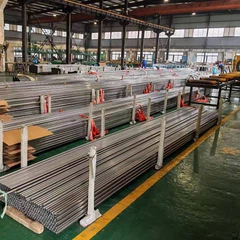
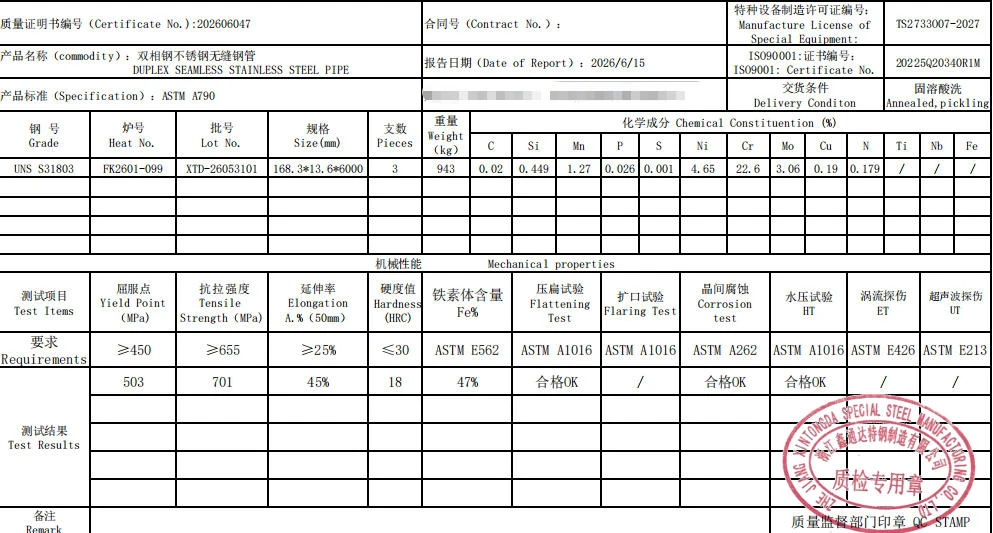
GNEE supplies Duplex 2101 and Duplex 2205 stainless steel pipes for industrial applications, manufactured according to ASTM A790 / ASME SA790 standards. Our duplex pipe range includes seamless and welded pipes, OD 6 mm–610 mm, wall thickness 0.5 mm–50 mm, with customized lengths, schedules, and surface finishes available. Each batch is supplied with EN 10204 3.1 MTC, PMI testing, chemical composition analysis, mechanical testing, hydrostatic testing, and dimensional inspection records to ensure material traceability and reliable performance in demanding environments.


Send Inquiry