







Inox 304 vs. Inox 316: Key Differences
Sep 21, 2026
Leave a message
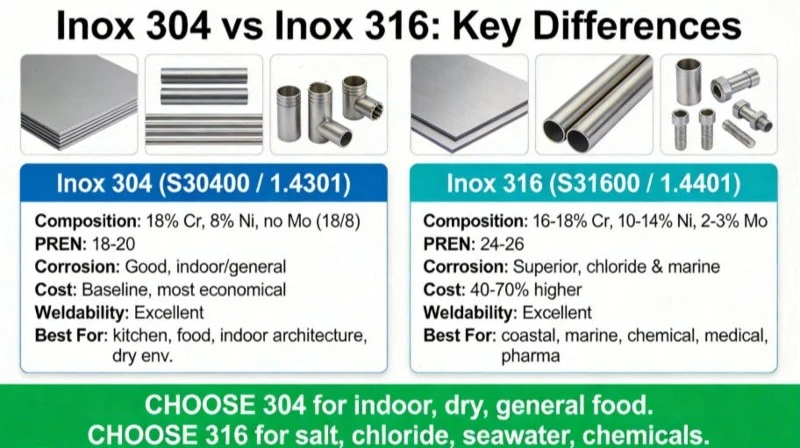
If you are looking for Inox 304 or Inox 316 stainless steel for industrial equipment, piping, food processing, marine, or chemical applications, understanding the difference between these two grades is essential for reducing material costs and avoiding corrosion problems. Both are austenitic Cr-Ni stainless steels, but Inox 316 contains 2–3% molybdenum (Mo), which provides better resistance to chloride corrosion compared with Inox 304.
This guide compares chemical composition, corrosion resistance, mechanical properties, applications, price differences, and purchasing considerations to help engineers, buyers, and distributors select the correct stainless steel grade.
What Is "Inox"?
"Inox" is the common term for stainless steel in French, Spanish, and Portuguese, derived from *INoxidable* (meaning "non-oxidizable"). In markets such as France, Belgium, Spain, Brazil, and North Africa, "Inox 304" and "Inox 316" are standard terms used in procurement, corresponding to "AISI 304 / 316" or "Type 304 / 316 Stainless Steel" in English-speaking markets.
What is Inox 304 stainless steel?
Inox 304 (corresponding grades: AISI 304 / EN 1.4301 / UNS S30400) is the most widely used grade of austenitic stainless steel globally. Due to its composition-containing approximately 18% chromium and 8% nickel-it is often referred to as "18/8 stainless steel." It is extensively used in food processing equipment, kitchenware, storage tanks, architectural structures, general industrial piping, and both residential and commercial applications. It is available in various forms, including sheets, plates, pipes, coils, and pipe fittings.
What is Inox 316 stainless steel?
Inox 316 (AISI 316 / EN 1.4401 / UNS S31600) is an austenitic stainless steel developed from 304 stainless steel by adding molybdenum, resulting in superior corrosion resistance.
Inox 316 is widely used in marine equipment, offshore structures, pharmaceutical equipment, chemical processing plants, coastal architecture, and heat exchangers.
What are the main differences between Inox 304 and Inox 316?
The key difference is that 316 contains 2–3% molybdenum (Mo), whereas 304 does not. This raises the PREN of 316 from ~19 to ~25, giving it significantly better resistance to pitting and crevice corrosion in chloride-rich environments compared to 304. Their mechanical properties are virtually identical.
Inox 304 vs. Inox 316 Chemical Composition
The most important difference between Inox 304 and Inox 316 is not chromium content but the addition of 2–3% molybdenum in 316, which improves localized corrosion resistance in chloride environments.
| Element | Inox 304 (AISI 304) | Inox 316 (AISI 316) |
|---|---|---|
| Carbon (C) | ≤0.08% | ≤0.08% |
| Chromium (Cr) | 18.0–20.0% | 16.0–18.0% |
| Nickel (Ni) | 8.0–10.5% | 10.0–14.0% |
| Molybdenum (Mo) | None | 2.0–3.0% |
| Manganese (Mn) | ≤2.0% | ≤2.0% |
| Silicon (Si) | ≤1.0% | ≤1.0% |
| Nitrogen (N) | ≤0.10% | ≤0.10% |
Inox 304 vs. Inox 316:Mechanical Properties
| Property | Inox 304 | Inox 316 |
|---|---|---|
| Tensile Strength | ~515–620 MPa | ~515–620 MPa |
| Yield Strength | ≥205 MPa | ≥205 MPa |
| Elongation | ≥40% | ≥40% |
| Density | 8.0 g/cm³ | 8.0 g/cm³ |
| Magnetic Property | Non-magnetic after annealing | Non-magnetic after annealing |
| Weldability | Excellent | Excellent |
Inox 304 vs. Inox 316:Equivalent Grades
| Standard System | Equivalent Grade for Inox 304 | Equivalent Grade for Inox 316 |
|---|---|---|
| AISI / ASTM | 304 | 316 |
| UNS | S30400 | S31600 |
| EN | 1.4301 | 1.4401 |
| DIN | X5CrNi18-10 | X5CrNiMo17-12-2 |
| BS | 304S31 | 316S31 |
| JIS | SUS 304 | SUS 316 |
| GB | 06Cr19Ni10 | 06Cr17Ni12Mo2 |
| GOST | 08Х18Н10 | 03Х17Н14М3 |
| NFC | Z3CNS17-12 | Z3CND17-12 |
Inox 304 vs. Inox 316:PREN
The higher PREN value of Inox 316 is mainly due to its 2–3% molybdenum (Mo) addition, which improves resistance to chloride-induced pitting and crevice corrosion. In chloride-containing environments such as seawater, coastal areas, and chemical processing systems, Inox 316 typically provides a longer service life than Inox 304.
| Grade | PREN Formula | Typical PREN Value | Meaning |
|---|---|---|---|
| Inox 304 | Cr + 3.3 × Mo + 16 × N ≈ 18 + 3.3 × 0 + 16 × 0 | ~18–19 | General pitting corrosion resistance |
| Inox 316 | Cr + 3.3 × Mo + 16 × N ≈ 17 + 3.3 × 2.5 + 16 × 0 | ~24–26 | Significantly better pitting resistance than Inox 304 |
Engineering Reference:
PREN < 20: Suitable for mild environments with limited chloride exposure
PREN 20–30: Suitable for moderate chloride environments
PREN > 30: Usually required for more aggressive chloride applications (depending on temperature and conditions)
Note: Actual PREN values vary according to the certified chemical composition shown in the MTC (Material Test Certificate), especially chromium, molybdenum, and nitrogen content.
Are 304 and 316 magnetic?
In the solution-annealed state, both are weakly magnetic or non-magnetic (austenitic structure). Slight magnetism may develop after cold working (due to martensitic transformation), but this does not affect corrosion resistance.
Can 304 and 316 be welded? What welding consumables should be used?
Both can be welded. Use E308/ER308 (or E308L/ER308L) for 304, and E316/ER316 (or E316L/ER316L) for 316. If no post-weld solution treatment is performed, "L" grade (304L/316L) base materials and welding consumables must be used.
Inox 304 vs. Inox 316: How to Choose?
Inox 304/304L: Suitable for general corrosion-resistant environments; widely available in stock; commonly used in kitchen equipment, architectural decoration, and food processing machinery.
Inox 316/316L: Contains molybdenum (Mo), offering superior resistance to chloride pitting corrosion; commonly used in marine engineering, chemical processing equipment, and medical devices.
Inox 304 / 316 Specifications
| Product Category | Available Forms | Typical Surface Finish |
| Flat Products | Sheets, Plates, Coils, Strips | 2B, No.1, BA, Hairline, Mirror |
| Long Products | Round Bars, Flat Bars, Square Bars, Hexagonal Bars | Pickled, Polished, Cold Drawn |
| Pipes & Tubes | Seamless Pipes, Welded Pipes, Square/Rectangular Tubes | Annealed & Pickled, Polished |
| Fittings | Elbows, Tees, Reducers, Caps, Stub Ends | Brushed, Sandblasted |
| Flanges | Weld Neck, Slip-on, Blind, Socket Weld, Lap Joint | Forged, Machined |
| Structural Shapes | Angles (L-shape), Channels (U-shape), I-Beams | Hot Rolled / Pickled |
| Wire & Mesh | Stainless Steel Wire, Wire Mesh, Perforated Sheets | Industrial Standard |
To obtain an accurate quote, we recommend providing the following key information:
Material Grade: (e.g., 304 or 316L)
Product Form: (e.g., Stainless Steel Plate or Seamless Pipe)
Dimensions: (Thickness × Width × Length, or OD × Wall Thickness)
Quantity: (Metric tons or number of pieces)
Surface Requirement: (e.g., 2B finish or Hairline)
Standard: (e.g., ASTM A240)
FAQ
Q: Can 304 replace 316 to save costs?
A: Only in environments free from chloride exposure. If the component comes into contact with seawater, salt spray, chloride-containing cleaners, de-icing salts, or coastal air, 304 will develop pitting corrosion within months to a couple of years. In these scenarios, 316 is not merely a "better choice" but a requirement.
Q: What are the maximum service temperatures for 304 and 316?
A: For both, the range is −196°C to 870°C (intermittent) / 925°C (continuous). Oxidation and creep issues must be considered if these temperatures are exceeded.
Q: Is 316 mandatory for buildings in coastal areas?
A: Yes. Within 5 km of the coast, the chloride (Cl⁻) concentration in salt spray is high enough to cause pitting and "tea staining" on 304 within months to a couple of years. 316 is the minimum requirement for coastal construction.
Q: Can 316 be used for continuous seawater immersion?
A: 316 is suitable for seawater splash zones (e.g., ship decks) but not for continuous seawater immersion. Continuous immersion requires 2205 duplex stainless steel (PREN ~34) or titanium alloys.
Q: How can 304 and 316 be distinguished?
A: They cannot be distinguished by the naked eye. Common methods include:
Magnet test: Both are weakly magnetic, so this method cannot distinguish between them.
Spectrometer (PMI): Detects Molybdenum (Mo) content (316 contains 2–3% Mo, whereas 304 does not).
MTC verification: Check the EN grade (1.4301 vs. 1.4401) or UNS number on the Material Test Certificate.
Send Inquiry