

Stainless Steel Angle Surface Treatments: Hot Rolled, Pickled, Polished and Passivated Finishes
May 13, 2025
Leave a message
Why Surface Finish Matters for Stainless Steel Angles
Stainless steel angle bars are used as structural framing, support brackets, handrail posts, edge trim and architectural details. In every one of those roles the surface is the part of the material that meets the environment, so the finish decides how the angle looks, how it cleans, and how long it keeps its corrosion resistance.
Stainless steel resists corrosion because of a chromium-rich passive film only a few nanometres thick. That film forms spontaneously in air, but it can be weakened by the oxide scale left behind by hot rolling, by a chromium-depleted layer created during hot working or welding, and by embedded iron contamination from carbon steel tooling. A correctly chosen surface treatment removes these weaknesses rather than simply making the bar shiny.
The finishes below cover the normal supply range for hot rolled and cold drawn stainless angles, from as-rolled structural stock to mirror-polished architectural trim.
As-Rolled and Descaling Treatments
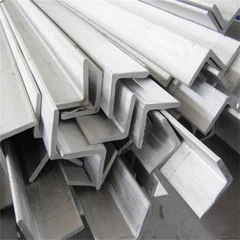
Hot rolled angles leave the mill with a dark, rough surface and a visible oxide scale produced at rolling temperature. Designated 1D or No.1 finish, this is the most economical condition and is normally acceptable only where appearance is secondary, such as concealed framing, support brackets and industrial steelwork.
Pickling removes that scale. The bar is immersed in an acid bath, usually based on nitric and hydrofluoric acid mixtures, which dissolves the oxide and the chromium-depleted layer underneath it and leaves a clean, uniform, light grey surface, designated 2D. Pickling is the standard pre-treatment before any corrosion-critical service, and it is also the correct way to remove weld heat tint and restore corrosion resistance beside a weld. Cleaning, descaling and passivation procedures of this type are described in ASTM A380.
A related mill finish, 2B, is produced on cold rolled sheet and is sometimes applied to cold finished angle by bright annealing. It is smoother and brighter than 2D and is a common starting point for components that will later be polished or brushed.
Mechanical Finishes: Polished, Brushed and Satin
Mechanical finishing uses abrasives to cut the surface to a controlled roughness. The appearance changes dramatically, and the smoother the finish, the less dirt, moisture and chloride can lodge on the surface, which helps the passive film stay intact.
| Finish | Process | Appearance | Typical use |
|---|---|---|---|
| No.1 / 1D | Hot rolled, annealed, descaled | Rough, dull, dark grey | Structural and concealed steelwork |
| 2D | Pickled after hot rolling | Clean, smooth, matte grey | Chemical, food and general industrial service |
| No.4 | Coarse abrasive belt grinding | Uniform short brushed lines | Architecture, interiors, appliances, furniture |
| Satin | Fine abrasive, low gloss | Soft matte, subdued reflection | Lift interiors, wall panels, commercial fit-out |
| No.8 | Progressive polishing to mirror level | Bright, reflective, mirror-like | Decorative trim, sanitary ware, display equipment |
| Bright annealed | Annealed in a controlled atmosphere | Bright, smooth, oxide-free | Precision parts and further forming |
Brushed No.4 finish remains the most widely specified architectural surface. The directional grain hides fingerprints and minor handling marks better than a polished surface, and it can be repaired on site by working in the same direction. Satin finishes reduce glare, which matters on large panels and in interior lighting.
Mirror polishing gives the highest reflectivity and the smoothest surface, but it also shows every scratch and fingerprint, and it costs more because it requires several successive abrasive stages. It is normally reserved for decorative or hygienic applications where appearance justifies the extra labour.
Chemical and Abrasive Treatments: Passivation and Sandblasting
Passivation is not a coating. The bar is cleaned and then treated in an acid solution, usually nitric acid or a citric acid formulation, to dissolve free iron and other foreign matter from the surface and encourage the natural chromium oxide film to reform in a uniform, chemically stable state. Chemical passivation treatments are specified in ASTM A967. Passivation changes neither the dimensions nor the appearance of the angle, and it is the standard final step after machining, pickling or blasting.
Sandblasting produces a uniform matte, non-reflective surface by projecting abrasive media at the bar. It is used for industrial and outdoor installations where a textured finish is acceptable and wear resistance matters, and it removes scale and heat tint at the same time.
Blasting carries one important risk. If the abrasive or the equipment has previously been used on carbon steel, iron particles are driven into the stainless surface and will rust in service. Blasting of stainless steel must use dedicated, iron-free media and clean equipment, and it should be followed by thorough cleaning and, where corrosion resistance is critical, by passivation.
Matching the Finish to the Service Environment
Dry indoor structural and concealed use: hot rolled 1D or 2D is sufficient and cheapest.
Visible interior architecture, furniture and appliances: No.4 brushed or satin.
Food, pharmaceutical and clean-room equipment: smooth, easy-cleaning surfaces, typically 2B, No.4 or polished, always passivated where corrosion resistance is specified.
Outdoor and coastal exposure: smooth finishes such as No.4 or polished, kept clean, because rougher surfaces retain salt and moisture and pit sooner.
Welded and heat-affected areas: pickle or mechanically clean and then passivate, since welding destroys the passive film locally.
Industrial machinery and heavy-duty outdoor framing: sandblasted matte finish where appearance is not critical.
Surface roughness and corrosion resistance are directly linked. A rough surface has more crevices and holds more deposits, so it starts to pit before a smooth one in the same environment. For coastal or chemical service, spending more on a smoother finish often extends service life more than moving to a higher alloy.
Handling after finishing also matters. Finished angles should be stored dry, separated from carbon steel, and protected from contact with iron-contaminated racking, since a single embedded iron particle can produce a rust bloom that looks like a material failure.
Frequently Asked Questions
Q: What is the difference between pickling and passivation?
Pickling removes the oxide scale and the chromium-depleted layer with a strong acid treatment. Passivation removes free iron contamination and lets the existing passive film reform. Pickling always changes the surface appearance; passivation normally does not.
Q: Which finish is best for coastal or outdoor use?
A smooth finish, typically No.4 brushed or polished, combined with pickling and passivation after fabrication. Smooth surfaces shed salt and moisture, so they resist pitting far better than rough or sandblasted surfaces in the same location.
Q: Does polishing improve corrosion resistance?
It helps indirectly. Polishing reduces surface roughness, so fewer deposits and chlorides are trapped on the surface, and the passive film is less likely to break down. Polishing does not change the alloy composition, so it cannot compensate for a grade that is unsuitable for the environment.
Q: What is a No.4 finish on stainless steel?
It is a brushed finish produced by grinding with progressively finer abrasive belts, leaving a uniform non-directional to slightly linear grain with a dull, low-reflection appearance. It is the most common architectural finish for stainless angle bars and sheet.
Q: Can a sandblasted stainless steel angle rust?
Yes, if the blasting media or equipment carried iron contamination, or if the operation compacted iron particles into the surface. Using dedicated iron-free media and passivating the finished part after cleaning prevents this.
Q: Is passivation required after welding stainless steel?
For corrosion-critical service, yes. Welding destroys the passive film and leaves heat tint and a chromium-depleted zone. After mechanical or chemical removal of the tint, the joint should be passivated so the whole component has a uniform, protective oxide film.
Send Inquiry