

TP304 Seamless Tube for High-Pressure Power Station Boiler Construction
Jun 11, 2025
Leave a message
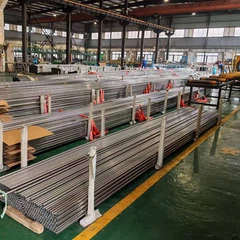
TP304 Tube for High-Pressure Power Station Boiler Construction
Power station boiler tubing has to hold pressure, resist oxidation on the fire side and resist corrosion on the water side, all while being bent, welded and expanded into headers during construction. TP304 stainless steel tube, specified under ASTM A213 and ASME SA213, performs that duty at lower cost than the stabilised and higher-alloy grades used in supercritical service, which makes it the standard entry point for high-pressure boiler construction.
What TP304 Tube Is
TP304 (UNS S30400) is an austenitic stainless steel with nominally 18% chromium and 8% nickel, giving a stable passive oxide film, good resistance to thermal cycling and useful mechanical properties at elevated temperature. The TP prefix identifies the tube product form in ASTM A213, which covers seamless ferritic and austenitic boiler, superheater and heat-exchanger tubes. Seamless cold-drawn tube is the normal supply for pressure parts; larger diameter fabricated pipe falls under ASTM A312 or A358.
Why Superheater and Steam Line Duty Suits TP304
Water walls and superheaters in thermal and nuclear plants run above 500 °C, and the water wall itself above 100 bar, in steam and feedwater that carries dissolved oxygen and trace chloride. TP304 is selected for four practical reasons.
Creep strength within its temperature range, with code allowable stresses tabulated across the relevant band
Resistance to scaling and thermal fatigue under repeated start-up and shutdown cycling
Weldability without preheat using matching austenitic filler for field installation and repair
Availability as seamless straight lengths and U-bends in the sizes boiler designers require
The limit is equally clear. Above roughly 550 °C, and wherever chloride in the steam is significant, TP316, TP321 or TP347H are substituted. TP347H is the usual answer for high-temperature superheaters where creep strength and resistance to polythionic acid attack during shutdown both matter.
Where TP304 Tubes Are Used in a Power Plant
Boiler water walls and superheater elements within the temperature limit
Steam pipelines, headers and connecting pipework
Preheaters, economisers and condensate return lines
Turbine heat exchange and cooling water tubing
Instrument impulse lines, sampling tubing and drain lines
Specification Range
| Parameter | Value |
|---|---|
| Standard | ASTM A213 / ASME SA213 |
| Grade | TP304 (UNS S30400) |
| Tube type | Seamless, cold drawn, required for boiler pressure parts |
| Size range | OD 6 mm to 101.6 mm; wall 0.5 mm to 5 mm |
| Tensile strength | At least 515 MPa |
| Yield strength | At least 205 MPa |
| Elongation | At least 35% |
| Heat treatment | Mandatory solution annealing at about 1040 °C |
| Non-destructive testing | Eddy current or hydrostatic test; ultrasonic testing on request |
| Certification | EN 10204 3.1 or 3.2; PED, ASME and IBR documentation |
Grade Comparison for Boiler Tubes
| Grade | Oxidation limit | Corrosion behaviour | Relative cost | Typical use case |
|---|---|---|---|---|
| TP304 | About 870 °C | Good in high-purity steam | Baseline | General boiler tubing and water walls |
| TP316 | About 870 °C | Higher, molybdenum added | Moderate | Chloride-rich steam and condensate |
| TP321 | About 870 °C | Similar, titanium stabilised | Moderate | Post-weld stability in the 425-815 °C band |
| TP347H | About 900 °C | Higher, niobium stabilised | Higher | High-temperature superheater tubing |
Testing, Certification and Construction Practicalities
Every A213 tube receives either a hydrostatic or an eddy current test, and project specifications for critical pressure parts frequently demand both. Solution annealing after cold drawing is mandatory and should be confirmed on the mill certificate together with flattening, reverse flattening and hardness results where specified. Certification for power work normally follows EN 10204 3.1, with 3.2 available under third-party witness, and PED, ASME and IBR documentation is prepared when the plant is built to those regimes.
On site the practical issues are bending radius control, weld heat input and cleanliness. Tube bores must be capped and purged during storage, because a stainless tube left open in a construction environment collects chloride-bearing dust that later causes pitting under the first moisture film. Interpass temperature during welding should be controlled to avoid sensitisation, and post-weld heat treatment is not normally applied to unstabilised austenitic grades.
Frequently Asked Questions
Q: Is TP304 acceptable for supercritical boiler tubing?
Usually not. Above roughly 550 °C and where chloride is present, design is dominated by creep strength and corrosion resistance, so TP316, TP321 or TP347H are selected instead.
Q: What is the difference between A213 TP304 and A312 TP304?
A213 covers seamless boiler, superheater and heat-exchanger tubes in smaller sizes, while A312 covers seamless and welded austenitic pipe including much larger diameters.
Q: Must boiler tubing be seamless?
For high-pressure pressure parts, seamless tube is the normal requirement. Welded tube is acceptable only where the specification permits it and the weld receives full examination.
Q: Which filler metal is used to weld TP304 boiler tube?
A matching austenitic filler such as ER308L or E308L is typical, welded with controlled heat input and interpass temperature to preserve corrosion resistance.
Q: Why is solution annealing so important for boiler tube?
It dissolves carbides and restores a homogeneous austenitic structure, which protects against intergranular corrosion and provides the ductility needed for bending and expansion into headers.
Q: What inspection records should accompany the tubes?
A mill test certificate with heat analysis, tensile, flattening and hardness results, the NDT method used, and the heat number linking each tube to its test record.
Send Inquiry