







What Are the Properties of EN 1.4002 Stainless Steel?
Apr 02, 2026
Leave a message
1.4002 stainless steel, commonly known as 405 or UNS S40500, is a low-carbon ferritic stainless steel designed specifically for applications requiring resistance to high-temperature oxidation and good corrosion resistance in mild environments, with improved weldability compared to higher-carbon ferritic grades. Its lower carbon content and aluminum addition help prevent hardening during welding and reduce susceptibility to intergranular corrosion, making it suitable for welded components in moderate temperature service.
Equivalent Grade for 1.4002 stainless steel
| Standard | Equivalent Grade |
|---|---|
| EN (Europe) | 1.4002 |
| ASTM/AISI (USA) | 405, UNS S40500 |
| JIS (Japan) | SUS405 |
| Common Name | 405 |
Chemical composition of 1.4002 stainless steel
| Element | C | Si | Mn | P | S | Cr | Al |
|---|---|---|---|---|---|---|---|
| Content (%) | ≤ 0.08 | ≤ 1.0 | ≤ 1.0 | ≤ 0.04 | ≤ 0.03 | 11.5 - 14.5 | 0.10 - 0.30 |
properties of 1.4002 stainless steel
| Property | Yield Strength (Rp0.2) | Tensile Strength (Rm) | Elongation (A) | Hardness (HB) |
|---|---|---|---|---|
| Typical Value | ≥ 205 MPa | 380 - 550 MPa | ≥ 20% | ≤ 190 |
Key Characteristics and Applications of 1.4002 / 405
Improved Weldability: The combination of low carbon and aluminum addition significantly improves weldability compared to other ferritic grades, reducing the tendency for grain growth and hardening in the heat-affected zone.
Good High-Temperature Oxidation Resistance: Provides adequate resistance to scaling and oxidation at elevated temperatures up to about 650°C, suitable for moderate-temperature applications.
Low Work Hardening Rate: Exhibits lower work hardening than austenitic grades, which can be advantageous for certain forming operations.
Magnetic and Cost-Effective: Strongly magnetic and more economical than nickel-containing austenitic grades.
Primary Applications:
Heat Exchangers: Components in moderate-temperature heat exchange equipment.
Petrochemical Equipment: Trays, linings, and internals in columns and vessels.
Annealing Equipment: Furnace parts, baskets, and fixtures operating at moderate temperatures.
Steam Nozzles: Components in steam systems.
Automotive: Exhaust system components in lower-temperature sections.
Architectural: Decorative applications where weldability is required.
How does 405 (1.4002) compare to 410 (1.4006) and 304 (1.4301)?
What are the welding considerations for 405?
What temperature range is 405 suitable for?
Looking for a Reliable Supplier of 1.4002 / 405 Stainless Steel?
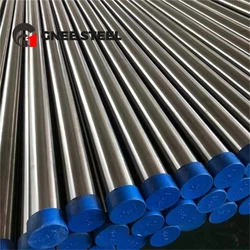
1.4002 Stainless Steel Pipe

1.4002 Stainless Steel Plate

1.4002 Stainless Steel Bar
Send Inquiry