







What is 1.4512 Stainless Steel?
Mar 04, 2026
Leave a message
1.4512 stainless steel, commonly known as 409 or UNS S40900, is a titanium-stabilized ferritic stainless steel. It offers good corrosion resistance and heat resistance at a lower cost than many austenitic grades, making it a popular choice for automotive exhaust systems, heat exchangers, and other applications where moderate corrosion resistance and high-temperature stability are required.
This economical ferritic grade is standardized under key international designations.
| Standard | Equivalent Grade |
|---|---|
| EN (Europe) | 1.4512 |
| ASTM/AISI (USA) | 409, UNS S40900 |
| JIS (Japan) | SUS409 |
| KS (Korea) | STS409 |
Titanium is added for stabilization and to improve weldability.
| Element | C | Si | Mn | P | S | Cr | Ti |
|---|---|---|---|---|---|---|---|
| Content (%) | ≤ 0.08 | ≤ 1.0 | ≤ 1.0 | ≤ 0.045 | ≤ 0.03 | 10.5 - 11.7 | 6xC min |
It provides moderate strength and good ductility in the annealed condition.
| Property | Yield Strength (Rp0.2) | Tensile Strength (Rm) | Elongation (A) | Hardness (HB) |
|---|---|---|---|---|
| Typical Value | ≥ 170 MPa | 380 - 550 MPa | ≥ 25% | ≤ 180 |
Key Characteristics and Applications of 1.4512 / 409
Good Heat and Corrosion Resistance: Offers adequate resistance to oxidation and scaling at elevated temperatures (up to approximately 700°C) and good resistance to exhaust gas condensate corrosion.
Cost-Effective: Lower nickel content makes it more economical than austenitic stainless steels, providing a good balance of performance and cost for many applications.
Magnetic and Weldable: Strongly magnetic in all conditions. Its ferritic structure and titanium stabilization make it suitable for welding, though care must be taken to avoid excessive grain growth.
Primary Applications:
Automotive Exhaust Systems: Mufflers, catalytic converter shells, tailpipes, and exhaust manifolds (for some applications).
Heat Exchangers: Components in automotive and industrial heating systems.
Agricultural Equipment: Parts requiring moderate corrosion resistance.
Structural Components: Non-critical architectural and industrial parts where appearance is not the primary concern.
How does 409 (1.4512) compare to 304 (1.4301) in terms of performance and cost?
Grade 409 is significantly less expensive than 304 due to its lower alloy content (no nickel, lower chromium). However, it also has lower overall corrosion resistance, particularly in chloride-containing environments, and is not suitable for highly corrosive or decorative applications. 409 is chosen for its cost-effectiveness and good performance in specific high-temperature, moderate-corrosion applications like automotive exhausts, where 304 would be over-specified and unnecessarily expensive.
What are the limitations of 409 stainless steel in welding applications?
Being a ferritic stainless steel, 409 is prone to grain coarsening in the heat-affected zone (HAZ) during welding, which can reduce ductility and toughness. To minimize this, low heat input welding techniques are recommended. Post-weld annealing can help restore some ductility but is not always practical. Its titanium content helps reduce susceptibility to intergranular corrosion after welding, but weld joint design and process control remain important.

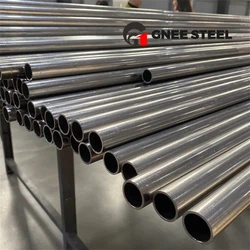


Looking for a Reliable Supplier of 1.4512 / 409 Stainless Steel?
GNEE Steel supplies cost-effective 409 (1.4512) stainless steel in sheet, coil, and tube forms, ideal for automotive and industrial applications. We provide material certification and processing support. If you have any requirements, please feel free to contact us.


Send Inquiry