







1.4567 Stainless Steel: Cold Formability & Fastener Applications
Mar 18, 2026
Leave a message
1.4567 stainless steel, commonly known as Nitronic 50 or UNS S20910, is a high-strength, nitrogen-strengthened austenitic stainless steel that offers an exceptional combination of high strength, excellent corrosion resistance, and outstanding wear and galling resistance. With its high nitrogen and manganese content, it achieves approximately twice the yield strength of conventional austenitic grades like 316L while maintaining excellent ductility and toughness. This makes it the material of choice for demanding applications in aerospace, marine, chemical processing, and high-stress fastener industries where both strength and corrosion resistance are critical.
Equivalent Grade for 1.4567 stainless steel
| Standard | Equivalent Grade |
|---|---|
| EN (Europe) | 1.4567 |
| ASTM/AISI (USA) | Nitronic 50, UNS S20910 |
| Common Name | Nitronic 50, 22-13-5 |
Chemical composition of 1.4567 stainless steel
| Element | C | Si | Mn | P | S | Cr | Ni | Mo | N | Nb+V |
|---|---|---|---|---|---|---|---|---|---|---|
| Content (%) | ≤ 0.06 | ≤ 1.0 | 4.0 - 6.0 | ≤ 0.04 | ≤ 0.03 | 20.5 - 23.5 | 11.5 - 13.5 | 1.5 - 3.0 | 0.20 - 0.40 | 0.10 - 0.30 |
Mechanical properties of 1.4567 stainless steel
| Property | Yield Strength (Rp0.2) | Tensile Strength (Rm) | Elongation (A) | Hardness (HB) |
|---|---|---|---|---|
| Typical Value | ≥ 380 MPa | 690 - 900 MPa | ≥ 35% | ≤ 250 |
Key Characteristics and Applications of 1.4567 / Nitronic 50
High Strength and Good Toughness: Provides approximately twice the yield strength of 316 stainless steel while maintaining excellent impact toughness, even at cryogenic temperatures down to -196°C.
Excellent Corrosion Resistance: Offers corrosion resistance superior to 316L in many environments, with better resistance to chloride pitting and crevice corrosion (PREN typically 32-35).
Outstanding Wear and Galling Resistance: Performs exceptionally well in moving contact applications, such as bearings, bushings, and valve components, due to its high work hardening rate and galling resistance superior to most stainless steels.
Non-Magnetic: Remains essentially non-magnetic even after severe cold working, making it suitable for instrumentation, medical, and electronic applications.
Primary Applications:
Aerospace: Fasteners, landing gear components, actuators, and high-stress structural parts.
Marine: Shafts, pumps, valves, fittings, and propeller components in seawater environments.
Chemical Processing: High-stress components, pump shafts, valve stems, and mixing equipment.
Oil & Gas: Downhole tools, wellhead components, high-pressure fasteners, and instrumentation.
Medical: Surgical instruments, implants, and medical device components.
Pulp & Paper: Doctor blades, cutter bars, and wear components in aggressive environments.
Food Processing: Equipment requiring high strength and corrosion resistance.
How does Nitronic 50 (1.4567) compare to 17-4PH (1.4542) and 316L (1.4404)?
What are the machining considerations for Nitronic 50?
What temperature range is Nitronic 50 suitable for?
Looking for a Reliable Supplier of 1.4567 / Nitronic 50 Stainless Steel?
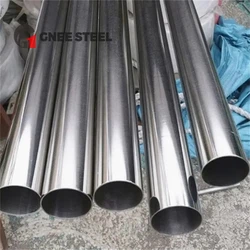
1.4567 Stainless Steel Pipe

1.4567 Stainless Steel Plate

1.4567 Stainless Steel Bar
Send Inquiry