







What is the difference between 3Cr13 and 420J2 steel?
Jul 09, 2026
Leave a message

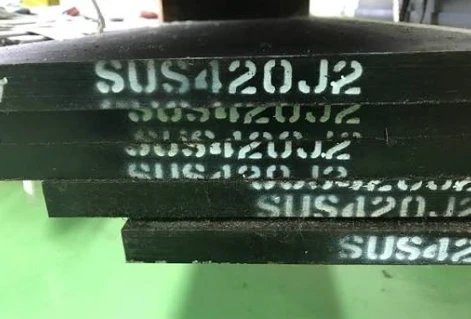
What is SUS420J2 stainless steel plate?
SUS420J2 is a Japanese (JIS) standard martensitic stainless steel plate, equivalent to American ASTM 420 grade and often known as 3Cr13. It is primarily characterized by a high carbon content (0.26–0.40%) and 12–14% chromium, which allow it to achieve exceptional hardness, wear resistance, and moderate corrosion resistance after heat treatment.
What is 3Cr13 stainless steel plate?
3Cr13 stainless steel plate is a hardenable, martensitic stainless steel. It contains roughly 0.3% carbon and 13% chromium. Highly valued for its affordability, strength, and moderate wear and rust resistance, it is frequently used to manufacture budget kitchen knives, cutlery, valves, and wear parts.


What is the difference between 3Cr13 and 420J2 steel?
3Cr13 and 420J2 are nearly identical martensitic stainless steels, and 3Cr13 is widely considered the Chinese equivalent of Japanese-standard 420J2. Both feature 12–14% chromium for rust resistance, but 3Cr13 contains slightly more carbon, allowing it to achieve a marginally higher hardness.
3Cr13vs. 420J2 stianless steel:Chemical Composition Comparison (%)
Values are based on standard specifications (GB/T 1220, ASTM A240, JIS G4303).
| Element | 3Cr13 (GB) | 420 (ASTM) | 420J2 (JIS) |
| Carbon (C) | 0.26 – 0.35 | 0.15 min | 0.26 – 0.40 |
| Chromium (Cr) | 12.00 – 14.00 | 12.00 – 14.00 | 12.00 – 14.00 |
| Manganese (Mn) | ≤ 1.00 | ≤ 1.00 | ≤ 1.00 |
| Silicon (Si) | ≤ 1.00 | ≤ 1.00 | ≤ 1.00 |
| Phosphorus (P) | ≤ 0.040 | ≤ 0.040 | ≤ 0.040 |
| Sulfur (S) | ≤ 0.030 | ≤ 0.030 | ≤ 0.030 |
| Nickel (Ni) | ≤ 0.60 | ≤ 0.75 | ≤ 0.60 |
3Cr13vs. 420J2 stianless steel:Mechanical Properties (Typical After Heat Treatment)
| Property | 3Cr13 | 420 | 420J2 |
| Hardness (HRC) | 50 – 54 | 50 – 55 | 50 – 53 |
| Tensile Strength (MPa) | ≥ 735 | ≥ 700 | ≥ 735 |
| Yield Strength (MPa) | ≥ 540 | ≥ 550 | ≥ 540 |
| Elongation (%) | ≥ 12% | ≥ 15% | ≥ 12% |
| Impact Energy (J) | ≥ 24 | - | - |
420J2 stianless steel Physical Properties
| Property | Value (Approximate for all three) |
| Density | 7.75 g/cm³ |
| Melting Point | 1450 – 1510 °C |
| Modulus of Elasticity | 200 GPa |
| Thermal Conductivity | 24.9 W/m·K (at 100°C) |
| Magnetism | Magnetic (in all conditions) |
What is 3Cr13 steel equivalent to?
3Cr13 steel is a Chinese budget-friendly martensitic stainless steel primarily equivalent to AISI 420J2 (US standard), as well as AISI 420, DIN X30Cr13, and SUS420J2. It is known for good corrosion resistance and is often used for kitchen knives, scissors, and EDC tools, with a typical hardness of 52-56 HRC.
| Region | Standard | Grade Designation |
| USA | ASTM / AISI | AISI 420 |
| China | GB/T | 3Cr13 (New: 30Cr13) |
| Germany | DIN / EN | 1.4028 / X30Cr13 |
| Japan | JIS | SUS420J2 |
| Europe | EN | X30Cr13 |
What is 2Cr13 material equivalent to?
Chinese 2Cr13 (also designated as 20Cr13) is a hardenable martensitic stainless steel. Its primary international equivalents are AISI 420 (USA), X20Cr13 or 1.4021 (Europe/EN), and SUS420J1 (Japan).
What is the difference between 2Cr13 and 3Cr13 stainless steel?
The primary difference between 2Cr13 and 3Cr13 stainless steel is their carbon content. 3Cr13 contains more carbon (0.26% - 0.35%) compared to 2Cr13 (0.16% - 0.25%). This variance makes 3Cr13 harder and stronger after heat treatment, while 2Cr13 offers better overall toughness and corrosion resistance.
Is 3Cr13 steel suitable for making kitchen knives?
Yes, it is well-suited for kitchen knives because it balances moderate hardness with good corrosion resistance; this makes it easy to sharpen at home while allowing the knife to retain a like-new appearance.
What is the HRC hardness of 3Cr13 steel after heat treatment?
After proper heat treatment (quenching and tempering), 3Cr13 stainless steel typically achieves a hardness ranging from 50 to 56 HRC. The exact number depends on the chosen tempering temperature; higher temperatures result in a softer, tougher blade, while lower tempering temperatures yield the maximum hardness of around 54–56 HRC.
Does 3Cr13 stainless steel have oxidation resistance?
Yes, 3Cr13 stainless steel has strong corrosion and oxidation resistance. Containing roughly 12-14% chromium, it forms a passive chromium oxide layer that protects it from rusting and oxidizing in normal atmospheric environments, mild acids, and organic compounds.
3Cr13 / 420J2 Stainless Steel Specification
| Product Form | Dimension Range (mm/inch) | Common Surface Finishes | Delivery Condition | Typical Applications |
| Cold Rolled Sheet / Coil |
Thickness: 0.3mm – 3.0mm Width: 600mm – 1250mm |
2B, BA, No.4, HL (Hairline), Mirror | Annealed (Soft) | Kitchenware, spacers, precision blades, springs. |
| Hot Rolled Plate |
Thickness: 3.0mm – 60.0mm Width: 1000mm – 2000mm |
No.1 (Pickled), Sand-blasted | Annealed or Quenched & Tempered | Heavy-duty tools, structural parts, mold bases. |
| Round Bar / Rod | Diameter: Φ2mm – Φ450mm | Bright (Cold Drawn), Peeled, Polished, Black (Hot Rolled) | Annealed or Q+T (Hardened) | Shafts, fasteners, surgical tools, valve stems. |
| Flat Bar / Strip |
Thickness: 2mm – 20mm Width: 10mm – 150mm |
No.1, Polished, Edged (Slit/Round) | Annealed or Hardened | Knife blanks, industrial shears, scrapers, rulers. |


Prior to shipment, all our products are supplied with an EN 10204 3.1 material certificate. This certificate details the heat number, chemical composition, mechanical properties, heat treatment status, and dimensional inspection results, ensuring full traceability between the product and its production batch. Upon customer request, we can also provide PMI (Positive Material Identification) spectral analysis reports, hardness test reports, third-party inspection reports (SGS, BV, TÜV), and factory inspection reports.


420J2 Stainless Steel Rod MTC
Send Inquiry