









ASTM A240 321H Hot Rolled Stainless Steel Coil
Grade:300 Series
Technique:cold Rolled
Sample:Availabled
Tolerance:5%
SurfaceBa/2b/No.1/No.3/No.4/8K/Hl/2D/1d
Thickness:0.15-100mm
Packing:Standard Sea-Worthy Packing
Delivery Time:8-14 Days
Length:Customers′ Requirement
SS 321H Hot Rolled Coils Exporter
ASTM A240 321H stainless steel coils feature a carbon content of 0.04–0.10% (an increase of approximately 25–50% compared to the ≤0.08% limit of Grade 321). This composition significantly enhances creep resistance above 537°C, resulting in creep strength within the 600–800°C range that is markedly superior to that of grades 304H and 321. With a titanium content ranging from ≥4×(C+N) up to 0.70%, the titanium preferentially bonds with carbon to form TiC; this effectively blocks the precipitation of Cr₂₃C₆ at grain boundaries, ensuring the material retains its intergranular corrosion resistance within the 425–850°C sensitization range and allowing for immediate service after welding without the need for solution treatment. The maximum continuous service temperature reaches 925°C (1,700°F), with intermittent service capabilities up to 950°C-far exceeding the limits of grades 304 (~870°C) and 316 (~870°C).
GNEE supplies 321H coils in thicknesses ranging from 0.3–4 mm (cold-rolled range) up to 10 mm (hot-rolled range), with widths of 1,000, 1,220, 1,250, or 1,500 mm (or customized according to drawings). Coil inner diameters are 508 mm or 610 mm, with a maximum coil weight of approximately 40 MT. Each coil is accompanied by an EN 10204 3.1 material certificate (including data on melt analysis, product analysis, tensile strength, bending, and hardness).


If you'd like to narrow this down, please let me know:
• What thickness and width dimensions you need?
• What quantity or weight you are looking to source?
• What industry or specific operating temperature this material will face?
Stainless Steel 321H HR Coils Specification
| Item | Specification |
|---|---|
| Material Grade | 321H Stainless Steel (UNS S32109 / EN 1.4878 / JIS SUS321H) |
| Product Form | Hot Rolled Coil (HR Coil) |
| Standards | ASTM A240, ASME SA240, EN 10088-2, JIS G4304 |
| Thickness Range | 3.0 mm – 16.0 mm |
| Width Options | 1000 mm / 1219 mm / 1500 mm / 1800 mm / 2000 mm |
| Length (cut-to-size) | 2000 mm / 2440 mm / 3000 mm / 6000 mm / Custom lengths |
| Tolerances | As per ASTM A480 / EN 10051 |
| Surface Finish | No.1 (Hot rolled, annealed & pickled), others on request |
321H Hot Rolled Stainless Steel Coil Chemical Composition (wt%)
| Element | Min | Max |
| C | 0.04 | 0.10 |
| Mn | - | 2.00 |
| Si | - | 0.75 |
| P | - | 0.045 |
| S | - | 0.030 |
| Cr | 17.0 | 19.0 |
| Ni | 9.0 | 12.0 |
| N | - | 0.10 |
| Ti | 4×(C+N) | 0.70 |
| Balance | Fe | - |
321H Coil Mechanical Properties (Annealed Condition)
| Property | Value | Unit |
| Tensile Strength (UTS) | ≥ 515 (75 ksi) | MPa |
| Yield Strength (0.2% offset) | ≥ 205 (30 ksi) | MPa |
| Elongation (2″ / 50 mm) | ≥ 40 | % |
| Hardness | ≤ 95 HRB / ≤ 217 HBW | - |
321H Hot Rolled Stainless Steel Coil Physical Properties
| Property | Value |
| Density (68 °F) | 7.92 / 0.286 g/cm³ / lb/in³ |
| Melting Range | 2550 – 2635 (1398 – 1446 °C) °F |
| Elastic Modulus (Annealed) | 29.0 × 10⁶ psi |
| Thermal Conductivity (200 °F) | 11.4 BTU/hr·ft·°F |
| Specific Heat (32–212 °F) | 0.12 BTU/lb·°F |
| Electrical Resistivity (68 °F) | 0.00029 Ω·cm |
| CTE (68–212 °F) | 9.2 × 10⁻⁶ in/in·°F |
| CTE (68–1112 °F) | 10.5 × 10⁻⁶ in/in·°F |
| CTE (68–1832 °F) | 11.4 × 10⁻⁶ in/in·°F |
321H Stainless Steel Temperature Limits
| Service Condition | Max Temp (°F) | Max Temp (°C) |
| Continuous (oxidation) | 1,700 | 925 |
| Intermittent (oxidation) | 1,650 | 900 |
| Recommended operating range | 800 – 1,500 | 427 – 816 |
| Hot forming (forging) | 2,100 – 2,300 | 1,149 – 1,260 |
| Do NOT work below | 1,700 | 927 |
How should one choose between 321H, 347H, and 310H for service temperatures above 900°C?
For pressure-bearing applications above 900°C, 310H is preferred due to its higher high-temperature oxidation resistance and service temperature capability. For non-pressure furnace linings and internal components, 310S provides sufficient heat resistance with lower cost. For pressure applications below 900°C, 321H is usually the most economical choice, offering a good balance of creep strength, corrosion resistance, and cost performance.
| Grade | Maximum Continuous Service Temperature | Creep Strength at 900°C / 10,000 h | Cost Index (321H = 1.0) | Typical Applications |
|---|---|---|---|---|
| 321H | 925°C | ~200 MPa | 1.0 | Superheater tubes, reheater tubes, economizer tubes |
| 347H | 925°C | ~190 MPa | 1.05 | Similar applications to 321H; Nb-stabilized alternative to Ti-stabilized grade |
| 310H | 1,150°C | ~120 MPa (at 900°C) | 1.8–2.2 | Furnace hearth plates, burner liners, high-temperature furnace components |
| 310S | 1,100°C | ~100 MPa (at 900°C) | 1.6–2.0 | Non-pressure furnace internals, heat-resistant structural parts |
Quality Inspection
All coil products are supplied with an EN 10204 3.1 material certificate, which includes heat number traceability information as well as data on chemical composition and mechanical properties. Inspection items cover direct-reading spectroscopic analysis, tensile testing in accordance with ASTM E8/A370 standards, hardness testing, thickness and width measurements, surface inspection, ultrasonic testing (where required), and verification of the titanium (Ti) stabilization requirement (Ti ≥ 5×(C+N)).

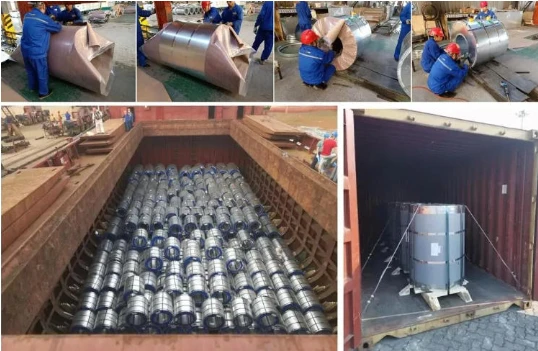
Standard export packaging


FAQ
What is the key difference between 321H and 321? What does the "H" stand for?
The "H" stands for High Carbon. 321H has a maximum carbon content of 0.10% (compared to ≤0.08% for 321), resulting in a creep strength that is approximately 15–25% higher at temperatures above 537°C. 321H is specifically intended for high-temperature pressure-bearing components (such as boiler tubes and reheaters), whereas 321 is used for general corrosion-resistant structural components.
What is the maximum service temperature for 321H hot-rolled coils? What happens if the temperature exceeds 925°C?
The upper limit for continuous service is 925°C (1,700°F), with intermittent service up to 950°C. Exceeding this temperature results in:
① An exponential increase in the oxidation rate (an Al₂O₃ film does not form, and the Cr₂O₃ film becomes thin and unstable).
② A drastic reduction in creep life (at 1,000°C, the rupture strength for 10,000 hours is only ~150 MPa).
What is the magnetic permeability of 321H hot-rolled coils? Can magnetic particle testing (MT) be used?
321H is an austenitic steel (face-centered cubic structure); in the annealed state, its magnetic permeability is close to 1.0 (indicating weak or no magnetism). If the material undergoes more than 30% deformation during hot working, a small amount of martensitic transformation may occur on the surface, resulting in weak magnetism (permeability of 1.05–1.2); however, magnetic particle testing (MT) is not suitable. Eddy current testing (ET) or liquid penetrant testing (PT) should be used for non-destructive testing.
Hot Tags: ASTM A240 321H Hot Rolled Stainless Steel Coil, China ASTM A240 321H Hot Rolled Stainless Steel Coil manufacturers, suppliers, factory, stainless steel coil humidity testing, stainless steel coil fatigue testing, 316L Stainless Steel Coil, stainless steel coil corrosion testing, Stainless Steel 304 Coil, 904L Hot Rolled Stainless Steel Coil
You Might Also Like


Send Inquiry