







ASTM A240 Grade 310S Solid metallic sheets
Sep 01, 2026
Leave a message
If you are looking for a high-alloy stainless steel plate capable of maintaining stable performance in high-temperature, thermal cycling, and oxidizing environments, ASTM A240 Grade 310S Solid Metallic Sheets are a material worth prioritizing for industrial furnaces, heat treatment equipment, chemical processing plants, and high-temperature structural components.
ASTM A240/A240M is the standard specification for stainless steel plate, sheet, and strip for pressure vessels and general industrial applications. Grade 310S is a low-carbon austenitic heat-resistant stainless steel containing 24.0–26.0% Cr, 19.0–22.0% Ni, and ≤0.08% C. This high-chromium, high-nickel design allows it to form a highly stable protective oxide film in high-temperature oxidizing environments. Compared to conventional stainless steels like 304 and 316, the greatest advantage of 310S is its superior resistance to high-temperature oxidation and thermal corrosion. Under appropriate oxidizing conditions, it can be used in continuous service at temperatures up to approximately 1050°C and peak temperatures of 1100°C.
In addition, 310S stainless steel plates offer excellent weldability and hot-working adaptability. They can be welded using common processes such as TIG, MIG, SMAW, and SAW, making them highly suitable for manufacturing furnace hearth plates, furnace doors, internal supports, heating furnace components, heat treatment equipment, incinerators, heat exchangers, and high-temperature chemical equipment.
We supply ASTM A240 310S stainless steel plates with thicknesses ranging from 0.3mm to 100mm, standard widths of 1000mm, 1219mm, 1500mm, and 2000mm, and lengths up to 12000mm. We also support custom precision waterjet and laser cutting according to drawings. Available surface finishes include 2B, BA, No.1, 1D, and HL, meeting the stringent surface quality requirements of various high-temperature applications.


Chemical Composition (ASTM A240 Standard)
The "S" in 310S denotes a lower carbon content compared to Grade 310, which minimizes carbide precipitation during welding or high-temperature service.
| Element | Carbon (C) | Manganese (Mn) | Silicon (Si) | Phosphorus (P) | Sulfur (S) | Chromium (Cr) | Nickel (Ni) |
| Weight (%) | ≤ 0.08 | ≤ 2.00 | ≤ 1.50 | ≤ 0.045 | ≤ 0.030 | 24.0 – 26.0 | 19.0 – 22.0 |
Mechanical Properties (at Room Temperature)
| Property | Value (Minimum) | Test Method |
| Tensile Strength | ≥ 515 MPa (75 ksi) | ASTM E8 |
| Yield Strength (0.2% Offset) | ≥ 205 MPa (30 ksi) | ASTM E8 |
| Elongation (in 50mm) | ≥ 40 % | ASTM E8 |
| Hardness (Brinell) | ≤ 217 HBW | ASTM E10 |
| Hardness (Rockwell B) | ≤ 95 HRB | ASTM E18 |
Physical Properties
| Property | Metric Value |
| Density | 7.98 g/cm³ |
| Melting Range | 1400 – 1450 °C |
| Modulus of Elasticity | 200 GPa |
| Electrical Resistivity | 780 nΩ·m (at 20°C) |
| Magnetic Permeability | < 1.02 (Non-magnetic) |
Thermal Performance & Oxidation Limits
310S is primarily used for its stability in high-temperature environments.
| Environment | Scaling Temperature (°C) | Scaling Temperature (°F) |
| Continuous Service (In Air) | 1150 °C | 2100 °F |
| Intermittent Service (In Air) | 1035 °C | 1900 °F |
| Thermal Expansion Coeff. | 15.9 µm/m·°C (0-100°C) | 8.8 µin/in·°F |
| Thermal Conductivity | 14.2 W/m·K (at 100°C) | 98.5 BTU·in/ft²·hr·°F |
310S stainless steel plates Applications
Furnace Components: Conveyor belts, rollers, burners, and refractory supports.
Petrochemical Processing: Heat exchangers, catalytic recovery systems, and flare tips.
Power Generation: Boiler tube hangers and pulverized coal burners.
Thermal Processing: Retorts, muffles, and annealing covers.
If you need help, tell me:What thickness and dimensions you require
The operating temperature of your projectI can help you determine if Grade 310S fits your exact needs.
ASTM A240 Grade 310S Solid Metallic Sheets HS Code
| Item | Description | HS Code | Typical Customs Description |
|---|---|---|---|
| Product | ASTM A240 Grade 310S Stainless Steel Sheets | 7219.90 | Flat-rolled products of stainless steel, width ≥600 mm, other |
| Cold-Rolled Sheet | 310S Cold-Rolled Stainless Steel Sheet | 7219.90 | Other flat-rolled products of stainless steel, cold-rolled |
| Hot-Rolled Sheet | 310S Hot-Rolled Stainless Steel Sheet | 7219.90 | Other flat-rolled products of stainless steel |
| Width <600 mm | 310S Stainless Steel Strip/Sheet | 7220.90 | Flat-rolled products of stainless steel, width <600 mm, other |
ASTM A240 Grade 310S plate price per ton
The price of ASTM A240 Grade 310S stainless steel plate typically ranges from $900 to $6,500 per metric ton, depending on the surface finish and processing method (hot-rolled or cold-rolled).
Base FOB price: $900 to $3,000 per ton for standard industrial-grade products;
Surface finish: Polished, mirror, or special bright finishes typically increase the base cost.
Quality Inspection
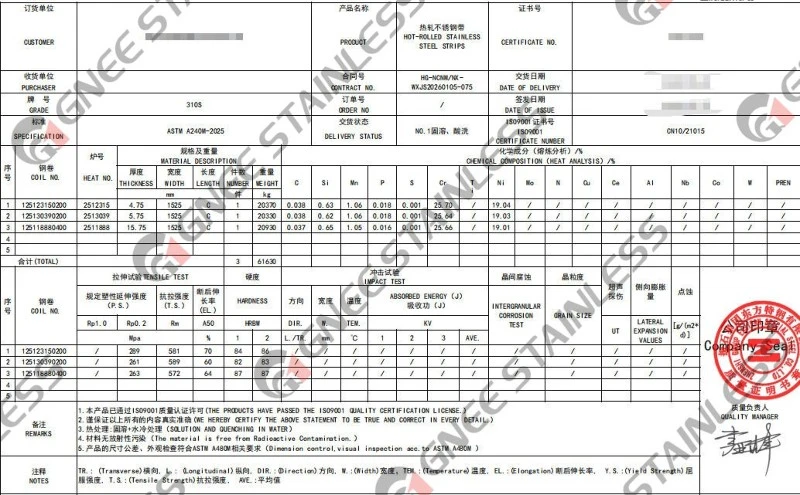
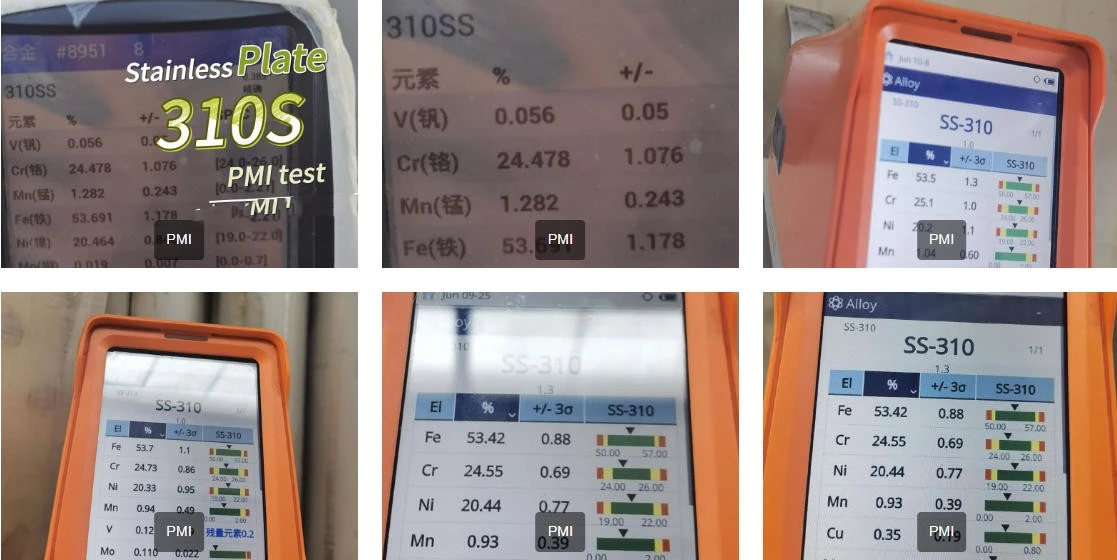
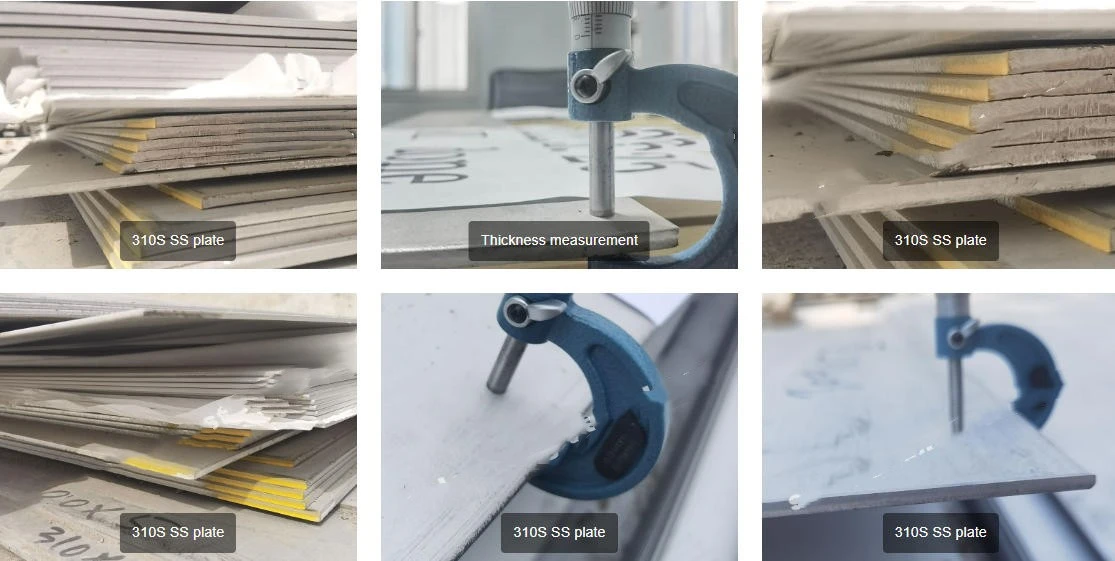
For ASTM A240 310S solid metal plates, GNEE conducts batch quality inspections covering chemical composition, mechanical properties, dimensions, surface condition, and heat treatment status. Thickness, width, length, and surface finish are measured using calibrated instruments; Ultrasonic Testing (UT) and other Non-Destructive Testing (NDT) services are also available upon request in accordance with procurement specifications. An EN 10204 3.1 Material Test Certificate (MTC) is provided for every batch to ensure traceability.
Standard export packaging
GNEE packages ASTM A240 310S stainless steel plates in strict accordance with export and maritime shipping requirements to minimize the risk of moisture, oxidation, scratches, and deformation. Protective paper or film is typically placed between the plates; after secure stacking, the bundle is wrapped in waterproof material and reinforced with steel strapping. Additionally, wooden pallets or export-grade wooden crates can be used depending on plate dimensions and customer requirements. Each package is clearly marked with the grade, ASTM A240 standard, dimensions, quantity, heat number, and gross/net weight to facilitate identification and receiving inspection.


FAQ
Q: What is the maximum service temperature for 310S?
Continuous service temperature: Up to 1150°C.
Intermittent service temperature: Approximately 1035°C.
Note: Prolonged exposure in the 450–850°C range can lead to sigma (σ) phase embrittlement, though the material performs excellently at high temperatures (>900°C).
Q: What is the difference between 310S and standard 310?
The "S" stands for "Low Carbon." 310S has a lower carbon content (≤0.08%) compared to 310 (≤0.25%). During welding or high-temperature service, 310S exhibits a reduced tendency for carbide precipitation, resulting in superior resistance to intergranular corrosion and better weldability.
Q: Why choose 310S over 304 or 316 for high-temperature environments?
Key point: Grades 304 and 316 suffer from severe oxidation and scaling at temperatures exceeding 800°C, leading to a loss of structural strength. Thanks to its high nickel and chromium content, 310S retains good mechanical properties and chemical stability even at temperatures above 1000°C.
Q: What welding consumables should be used for 310S stainless steel plate?
Key point: It is generally recommended to use matching consumables, such as ER310 welding wire or E310-16 welding electrodes.
Precautions: 310S is prone to hot cracking during welding; therefore, the interpass temperature should be controlled (recommended <150°C), and high heat input should be avoided.
Send Inquiry