

ASTM B862 Grade 2 Titanium Welded Pipe for Boiler Heat Exchangers
Oct 28, 2025
Leave a message
What ASTM B862 Covers
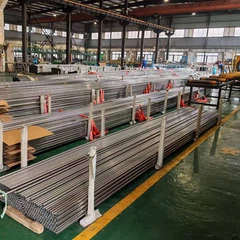
ASTM B862 is the specification for welded titanium and titanium alloy pipe. Where ASTM B861 covers the seamless product and ASTM B338 covers welded and seamless tube for condensers and heat exchangers, B862 is written specifically for pipe made by welding strip or plate into a tubular section. Grade 2, listed as UNS R50400, is the workhorse of the family: commercially pure titanium with an excellent balance of strength, ductility, weldability and corrosion resistance, and the grade most often selected for boiler and heat exchanger duty.
The commercial case for the material is simple. Titanium forms a thin, tightly adherent oxide film that repairs itself instantly in air or water, so the metal is inert to seawater, chlorides and many oxidising acids. In condenser and boiler circuits this film keeps the tube wall clean and free of the scale that destroys heat transfer in carbon steel and copper alloys.
Chemical Composition of Grade 2 (UNS R50400)
| Element | Maximum, % by weight |
|---|---|
| Titanium (Ti) | balance |
| Iron (Fe) | 0.30 |
| Carbon (C) | 0.08 |
| Nitrogen (N) | 0.03 |
| Hydrogen (H) | 0.015 |
| Oxygen (O) | 0.25 |
Oxygen and iron are the elements that raise strength in commercially pure titanium, so the tight limits above are also what keep the grade predictable from lot to lot. Hydrogen is limited because absorbed hydrogen can form brittle hydrides in service.
Mechanical Properties
| Property | Grade 1 | Grade 2 |
|---|---|---|
| Tensile strength, min | 240 MPa (35 ksi) | 345 MPa (50 ksi) |
| Yield strength, 0.2% offset, min | 170 MPa (25 ksi) | 275 MPa (40 ksi) |
| Tensile strength, max | 310 MPa (45 ksi) | 450 MPa (65 ksi) |
| Elongation in 50 mm, min | 24% | 20% |
| Density | 4.51 g/cm3 | 4.51 g/cm3 |
Grade 2 is roughly 40% stronger than Grade 1 at the same density, which is why it is the default choice for pressure retaining heat exchanger and boiler components. The density is about 60% that of steel, so a titanium tube bundle weighs far less than the equivalent steel or copper alloy bundle and demands less support structure.
Welding, Annealing and Surface Condition
Titanium must be welded under fully inert shielding. Pipe is normally produced by gas tungsten arc welding (GTAW) or plasma welding, with trailing shields and purge gas protecting the weld pool, the hot bead and the root until the metal has cooled below roughly 400 °C. Any air contamination at that stage produces a coloured oxide that embrittles the seam, so weld colour is inspected as a routine quality check. After welding the pipe is annealed to relieve residual stress from forming and welding.
Welding processes: GTAW and plasma, autogenous welds, argon shielding and backing purge
Heat treatment: stress relief or full anneal to restore ductility
Surface options: pickled and annealed, or bright annealed
Inner wall condition: smooth, free of oxide residue, to limit scaling and protect heat transfer efficiency
Ends: plain or beveled, ready for tube sheet or header assembly
Size Range, Delivery Condition and Testing
| Item | Range |
|---|---|
| Welded pipe outside diameter | 1 in NB to 16 in NB nominal bore |
| Wall thickness | Schedule 10 to Schedule 160 |
| Length | 5 to 7 m, 9 to 13 m, single or double random, cut to size |
| Delivery condition | Annealed, stress relieved, pickled, bright annealed |
| Coating and finishing | Electropolished, mechanically polished, satin, passivated |
| Value added work | Drawing, expansion, machining, blasting, heat treatment |
| Testing | Chemical and mechanical tests, flattening, flaring, hydraulic, eddy current, ultrasonic |
| Certification | EN 10204 3.1 or 3.2 mill certificate, third-party agency inspection |
Order the product against ASTM B862 for welded pipe and confirm the tube specification separately when condenser or heat exchanger tubing to ASTM B338 is required. Both routes can be supplied from the same mill but the dimensional and test requirements differ.
Service Conditions in Boilers and Heat Exchangers
Grade 2 titanium pipe is chosen for high temperature, high pressure and continuously corrosive streams: seawater cooled condensers, desalination units, chemical reactor heat exchange bundles, and flue gas or process gas coolers. The operating window commonly quoted for these duties is 300 to 350 °C, above which oxidation and creep behaviour must be reviewed against the design life.
The practical advantages at the plant level are longer intervals between shutdowns, no requirement for corrosion allowance, and tube walls that stay smooth enough to hold design heat transfer coefficients for years. Titanium also tolerates the residual chlorine dosing used to control marine biofouling, which is what makes it the default tube material for seawater condensers.
Two limits deserve attention during design. Titanium resists chloride attack, but it can be attacked by dry chlorine gas, methanol and some anhydrous media, and it must not be coupled to less noble metals without considering galvanic effects. Hydrogen pickup is also a risk where cathodic protection is applied, so the wall temperature and polarisation level should be reviewed together.
Frequently Asked Questions
Q: Is Grade 2 the same as Ti2?
Yes. Ti2 is a shortened trade way of writing ASTM Grade 2 titanium, the commercially pure grade with UNS number R50400 and the strength level of 345 MPa minimum tensile.
Q: Why is ASTM B862 used instead of ASTM B338?
ASTM B862 governs welded pipe, while ASTM B338 covers welded and seamless tube for condensers and heat exchangers. For boiler pipework and headers, B862 is the correct welded pipe specification.
Q: What welding process is used and why does weld colour matter?
Gas tungsten arc or plasma welding with full argon shielding. A silvery weld is acceptable, while blue, purple or grey oxide indicates air contamination and a brittle, less corrosion resistant seam.
Q: Which tests are performed on each batch?
Chemical composition and mechanical properties are mandatory. Flattening, flaring, hydraulic, eddy current and ultrasonic tests are added according to the specification or the customer purchase order.
Q: How much lighter is a titanium tube bundle than steel?
Titanium density is about 4.51 g/cm3 against roughly 7.85 g/cm3 for steel, so a titanium bundle is about 60% of the steel weight and reduces support and handling loads at the same time as it removes the corrosion allowance.
Q: What surface finish should be ordered for condenser duty?
Pickled and annealed is the usual starting point, and bright annealed or electropolished bores are chosen where deposit formation or cleaning cycles are critical. In all cases the bore must be free of oxide residue.
Send Inquiry