

SS 316 Sheet Price Per kg Today [2026 FOB Price List]
Apr 15, 2026
Leave a message
If you are sourcing stainless steel, understanding the price per kilogram of 316 stainless steel sheet in 2026 is crucial for budgeting, supplier comparison, and cost control. The price (per kilogram) of 316/316L stainless steel sheet fluctuates significantly and is updated daily with changes in raw material costs, primarily influenced by soaring molybdenum prices (up approximately 40% year-to-date) and higher nickel prices on the London Metal Exchange (LME). Prices are adjusted weekly based on alloy costs, mill surcharges, and order volume.
What is the price per kg for SS 316 sheet?
As of September, 2026, Based on current stainless steel market trends, the FOB price for Chinese-origin 316/316L stainless steel sheets/plates is roughly as follows: Cold-Rolled 2B Finish (thickness 0.5–3.0 mm) is approximately USD 3.80–4.50/kg, and Hot-Rolled No.1 Finish (thickness 3–50 mm) is approximately USD 3.20–4.00/kg; final quotes will be adjusted based on thickness, surface finish, order volume, nickel/molybdenum costs, and certification requirements.
What factors affect the price of 316 stainless steel sheets?
1. Raw Material Costs:
316 stainless steel contains 10-14% nickel. Fluctuations in nickel prices on the London Metal Exchange (LME) directly determine the base price. Molybdenum prices are very expensive and volatile; when molybdenum prices rise, the premium for 316 is significantly higher than for 304.
LME Nickel Price Trend Chart

2. Production Process and Specifications:
316 cold-rolled sheets have a smoother surface, more precise dimensions, and are typically thinner (0.3mm - 3.0mm). Their unit price (per kg) is usually higher than that of thicker hot-rolled sheets.
316 hot-rolled sheets have a rougher surface, are typically thicker (over 3.0mm), require fewer processing steps, and have a relatively lower base price.
3. Sheet Sizes and Tolerances:
Standard sizes (e.g., 1219x2438mm) have the most stable prices. Custom-made widths or extra-long sheets incur waste costs, which are usually higher.
4. Market Supply and Demand Dynamics:
Prices remain relatively stable when large suppliers like GNEE have ample inventory; spot prices surge when the entire industry experiences shortages. Peak demand seasons in the chemical, pharmaceutical, and marine engineering industries (typically the second and fourth quarters) drive up prices.
How much extra do different finishes (2B, No. 4, Mirror) cost?
The surface finish adds to the base price:
2B (Cold Rolled, Smooth): Base price (Cheapest).
No. 4 / Brushed: Adds $0.20 - $0.40 per kg.
Mirror Finish (8K): Adds $0.80 - $1.50 per kg due to the intensive polishing process.
PVC Coating: Most suppliers charge a small additional fee to add a protective plastic film to prevent scratches.
304 vs 316 Stainless Steel Plate Prices (September 2026)
As of early September 2026, China's stainless steel sheet baseline price index closed at 13,108 RMB/ton, up 8.4% year-on-year. In contrast, 316L plate/sheet prices remain high: cold-rolled sheet stands at 29,000–31,000 RMB/ton, while hot-rolled plate is around 29,400 RMB/ton. Under identical thickness and surface finish conditions, 316L commands a premium of roughly 90%–100% over 304-significantly exceeding the 25%–40% premium typical in general market guides. The rise in molybdenum prices throughout 2026 has further widened this price gap. On the export front, FOB quotes for Chinese-origin 304 sheet/plate are approximately USD 1,250–1,300/ton, while 316/316L sheet/coil prices range from USD 1,810 to 1,860/ton; certified 4×8 ft specification sheets, depending on the mill and Mill Test Certificate (MTC) requirements, can reach USD 3,800–4,400/ton. Before finalizing orders, buyers should ensure they request an EN 10204 3.1 Mill Test Certificate and perform on-site PMI (Positive Material Identification) verification.
Why is 316 more expensive than 304?
Grade 316 stainless steel is generally 88% to 100% more expensive than 304 due to the addition of molybdenum (typically 2-3%), a costly alloying element that significantly boosts corrosion resistance, particularly against salt and chlorides. Furthermore, 316 often contains higher nickel content, requires more complex manufacturing processes, and is used in more demanding applications, increasing its overall demand and production costs.
Why did I get different quotes from different suppliers?
Stainless steel pricing is not centralized like a retail store. Variations occur because:
Origin: Material from premium European or Japanese mills is more expensive than material from large-scale Asian mills.
Stock vs. Fresh Production: Local stockholders might charge more to cover warehousing costs, whereas buying "indent" (direct from the mill) is cheaper but takes longer.
Certification: Material with full MTC (Mill Test Certificate) and ASTM compliance is priced higher than "commercial grade" or "seconds."
GNEE Advice for Buyers
Due to the fact that stainless steel prices fluctuate daily with the LME nickel price, it is recommended that for large project inquiries, the quotation validity period is typically limited to 3–7 days.
If you need the latest SS 316 sheet price per kg today, please provide the following information so we can calculate a real-time and competitive quote:
Thickness and dimensions
Surface finish requirements
Estimated total purchase quantity
Destination country (for calculating duties and freight costs)
Click to get the latest prices for 316 stainless steel sheets
ASTM A240 316/316L Stainless Steel Plate Suppliers and Manufacturers
GNEE can customize stainless steel sheets, whether extra-thick, extra-wide, or requiring special tolerances; we have established supply channels.
We supply a full range of 316 series products, covering everything from ultra-thin foils to extra-thick industrial plates.
| Feature | Specifications & Range |
|---|---|
| Material Grades | AISI 316, 316L (Low Carbon), 316Ti (Titanium Stabilized), 316H (High Carbon) |
| Cold Rolled Sheets | Thickness: 0.3 mm – 6.0 mm Width: 1000 mm, 1219 mm, 1500 mm, 2000 mm |
| Hot Rolled Plates | Thickness: 3.0 mm – 120 mm Width: 1500 mm, 1800 mm, 2000 mm, 2500 mm |
| Supply Condition | Annealed & Pickled |
| Standards | ASTM A240, ASME SA240, EN 10088-2, JIS G4304 |
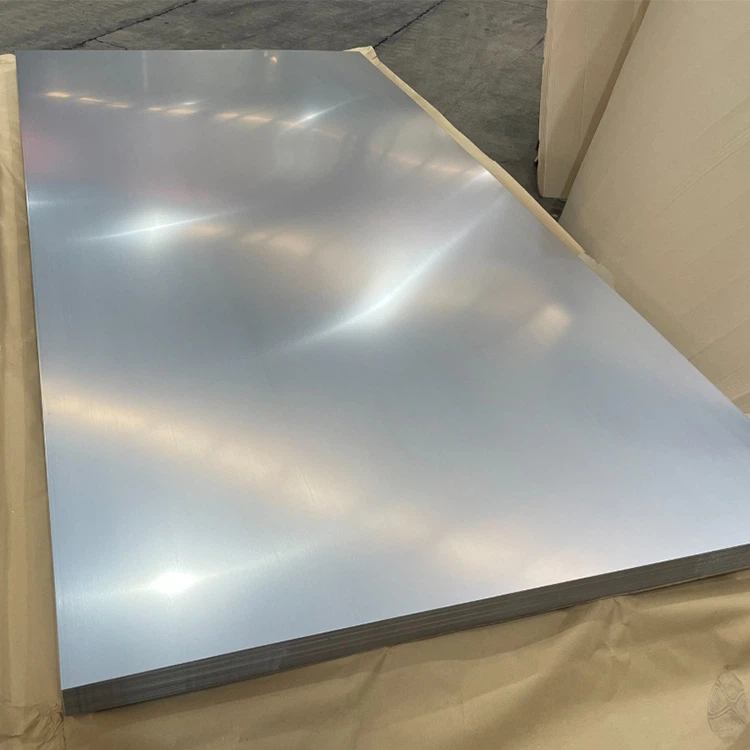
316 Stainless Steel Cold Rolled Sheet
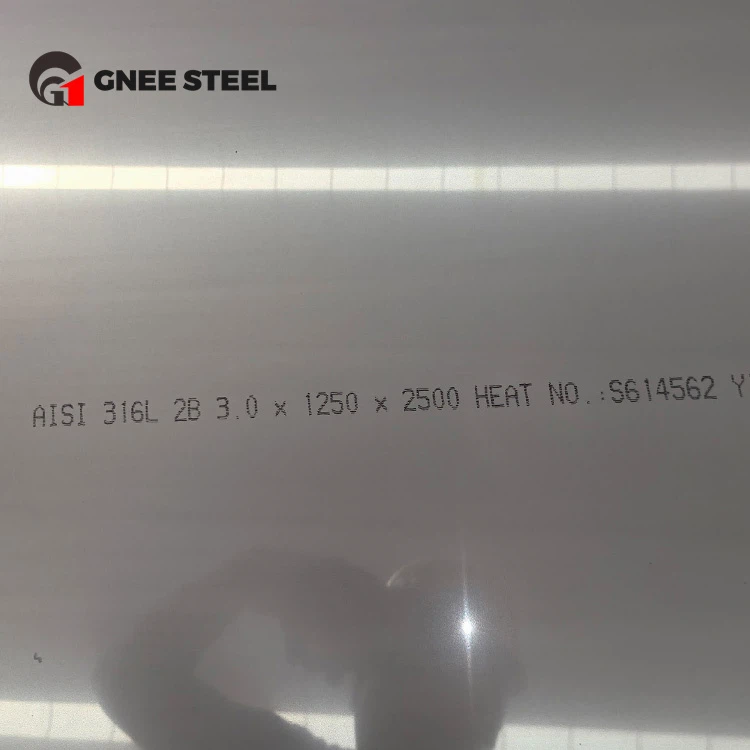
SS 316 Cold Rolled Sheet Thickness (Gauge to mm/inch)
Cold rolled sheets are generally used for applications requiring a smooth finish and precise dimensions (0.3mm to 6.0mm).
| Gauge (GA) | Thickness (Decimal Inch) | Thickness (Millimeters - mm) | Standard Tolerance (Approx. ±) |
| 26 GA | 0.018" | 0.45 mm | 0.05 mm |
| 24 GA | 0.024" | 0.61 mm | 0.05 mm |
| 22 GA | 0.030" | 0.76 mm | 0.06 mm |
| 20 GA | 0.036" | 0.91 mm | 0.08 mm |
| 18 GA | 0.048" | 1.21 mm | 0.10 mm |
| 16 GA | 0.060" | 1.52 mm | 0.12 mm |
| 14 GA | 0.075" | 1.90 mm | 0.15 mm |
| 12 GA | 0.105" | 2.66 mm | 0.18 mm |
| 11 GA | 0.120" | 3.04 mm | 0.20 mm |
| 10 GA | 0.135" | 3.42 mm | 0.22 mm |
| 7 GA | 0.187" | 4.76 mm | 0.25 mm |
SS 316 Hot Rolled Plate Thickness (Metric & Imperial)
Hot rolled plates (No. 1 finish) are used for heavy-duty industrial applications such as chemical tanks and pressure vessels.
| Metric Thickness (mm) | Imperial Equivalent (inch) | Weight per Square Meter ( kg/m ²) | Typical Application |
| 3.0 mm | 0.118" (11 GA) | 24.0 kg | Ducting, Liners |
| 4.0 mm | 0.157" | 32.0 kg | Storage Tanks |
| 5.0 mm | 0.197" | 40.0 kg | Structural Supports |
| 6.0 mm | 0.236" (1/4") | 48.0 kg | Pressure Vessel Shells |
| 8.0 mm | 0.315" (5/16") | 64.0 kg | Marine Components |
| 10.0 mm | 0.393" (3/8") | 80.0 kg | Chemical Processing |
| 12.0 mm | 0.472" | 96.0 kg | Heavy Flanges |
| 16.0 mm | 0.630" (5/8") | 128.0 kg | Offshore Platforms |
| 20.0 mm | 0.787" (3/4") | 160.0 kg | High-Pressure Tanks |
| 25.0 mm | 1.000" (1") | 200.0 kg | Heavy Machinery Bases |
| 50.0 mm+ | 2.000"+ | 400.0 kg+ | Specialized Engineering |
ASTM A480 Standard Thickness Tolerances (Reference)
According to ASTM A480 (Cold Rolled) and EN 10029 (Hot Rolled Class A).
| Nominal Thickness (mm) | ASTM A480 Tolerance (mm) | EN 10029 (Class A) Tolerance | Typical Actual Thickness (mm) |
| 0.5 – 1.0 | ± 0.05 | -0.30 / +0.40 | 0.46 – 0.95 |
| 1.2 – 3.0 | ± 0.10 | -0.30 / +0.50 | 1.12 – 2.90 |
| 4.0 – 8.0 | ± 0.20 | -0.40 / +0.70 | 3.70 – 7.70 |
| 10.0 – 20.0 | ± 0.30 | -0.60 / +1.10 | 9.40 – 19.50 |
| 25.0 – 50.0 | ± 0.50 | -0.80 / +1.50 | 24.20 – 49.30 |
Quality Control
PMI Testing (Material Identification): On-site spectral analysis to ensure molybdenum (Mo) content meets standards (2.0% - 3.0%).
Dimensional Inspection: Rigorous checks on thickness tolerance, flatness, and diagonal accuracy.
Mechanical Property Testing: Tensile testing, hardness testing, and impact resistance testing.
Certification Support: Providing a complete MTC (Material Certificate) in accordance with EN 10204 3.1, and supporting third-party testing (SGS/BV).,

316 Plate PMI

Dimensional Inspection

EN 10204 3.1 Material Certificate

SS 316 Sheet Packaging
GNEE employs export-grade protective packaging solutions. Each batch of SS 316 stainless steel sheets is secured using moisture-proof PE film, kraft paper, PVC protective film, and steel strapping. Anti-scratch separator layers are applied to the surfaces, edges and corners are reinforced with protectors, and the sheets are packed on ISPM 15-compliant fumigated wooden pallets or in wooden crates. Each package is clearly labeled with material specifications, heat/batch numbers, weight, and order details, ensuring safe arrival at customer project sites worldwide-free from rust, scratches, or deformation-during 30–60 day ocean transits.

How can I get the most accurate price today?
To get an exact quote, you should provide the supplier with the following details:
Grade: SS 316 or SS 316L (Low carbon).
Dimensions: Length x Width x Thickness.
Finish: (e.g., 2B, BA, No. 4).
Quantity: Total weight or number of sheets.
Location: For shipping/logistics calculation.
Send Inquiry