







304 Vs 316L Stainless Steel Bar Price Trends in 2026
Apr 21, 2026
Leave a message
The global stainless steel market is entering a phase of high risk and high volatility. From late 2025 to early 2026, the price difference between AISI 304 and 316L stainless steel bars is expected to fluctuate between 35% and 52%, primarily due to a 15% increase in molybdenum (Mo) spot prices and nickel (Ni) prices remaining stable at approximately US$16,500-18,500 per ton. For buyers with a focus on 2026, it is recommended that clients with purchasing plans lock in prices and place orders as early as possible to mitigate the risk of subsequent price increases.
304/316L Stainless Steel Bar Price Increase Analysis (September 2026 Update)
Based on three rounds of market quotation data on August 31, September 2, and September 4, prices for 304 and 316L stainless steel bars maintained an overall upward trend, with cumulative gains widening across various specifications:
304 Stainless Steel Bar: Cumulative increase of approx. USD 45–75/ton
316L Stainless Steel Bar: Cumulative increase of approx. USD 50–105/ton
321 Stainless Steel Round Bar: Cumulative increase of approx. USD 45–65/ton
This round of price increases was driven primarily by rising costs of alloy raw materials such as nickel and chromium, upward fluctuations in stainless steel futures prices, and a recovery in manufacturing restock demand. In particular, because 316L contains molybdenum (Mo), it is more sensitive to price shifts in ferromolybdenum and nickel, resulting in a higher price increase than the 304 series. As procurement demand in machinery manufacturing, chemical equipment, food processing, and the energy sector gradually picks up, the market is expected to maintain a strong operating posture in September, with stainless steel bar prices remaining high and volatile in the short term.
(Note: Actual FOB quotes will still be adjusted based on diameter specifications, surface finishes [black/bright/ground], order volume, MTC certification, and destination port requirements.)
2026 Latest Price Trends for 304/316L Stainless Steel Bars

304 vs 316L Stainless Steel Round Bar Price Trend (August–September 2026 FOB China Price)
| Material Grade | Size Range (mm) | August 2026 Price (USD/MT) | Change | September 2026 Price (USD/MT) | Change |
|---|---|---|---|---|---|
| S30400 | 21–45 | 2050 | +42 | 2092 | +42 |
| 65/75/90/105/125/130 | 1995 | +42 | 2037 | +42 | |
| 70/80/100/110/120 | 1995 | +42 | 2037 | +42 | |
| 85/95/115 | 1995 | +42 | 2037 | +42 | |
| 150 | 1995 | +42 | 2037 | +42 | |
| 160/180/200/240/250 | 1953 | +42 | 1995 | +42 | |
| 300/350 | 1967 | +42 | 2009 | +42 | |
| 300/350 (Piercing Grade) | 2009 | +42 | 2051 | +42 | |
| 400/450/500/600 | 2009 | +42 | 2051 | +42 | |
| 400/450/500/600 (Piercing Grade) | 2050 | +42 | 2092 | +42 | |
| 304A | 65–130 | 1981 | +42 | 2023 | +42 |
| 316L | 21–45 | 3790 | +55 | 3845 | +55 |
| 65/75/90/105/125/130 | 3720 | +55 | 3775 | +55 | |
| 70/80/100/110/120 | 3748 | +55 | 3803 | +55 | |
| 85/95/115 | 3762 | +55 | 3817 | +55 | |
| 150 | 3755 | +55 | 3810 | +55 | |
| 160/180/200/240/250 | 3692 | +55 | 3747 | +55 | |
| 300/350 | 3706 | +55 | 3761 | +55 | |
| 300/350 (Piercing Grade) | 3748 | +55 | 3803 | +55 | |
| 400/450/500/600 | 3734 | +55 | 3789 | +55 | |
| 400/450/500/600 (Piercing Grade) | 3776 | +55 | 3831 | +55 |
Market Summary (September 2026):
According to the latest FOB China quotations, 304 stainless steel round bar prices increased by approximately USD 42–50/MT from August to September 2026, while 316L stainless steel round bars recorded stronger gains of around USD 55–60/MT due to higher nickel and molybdenum alloy costs. Demand recovery in chemical processing, machinery manufacturing, food equipment, and energy projects continues to support stainless steel bar prices, with the market maintaining a firm upward trend in September 2026.
Recently, prices have been rising continuously. Customers with purchasing plans are advised to lock in prices and place orders in advance to avoid the risk of subsequent price increases. In addition to the standard specifications listed in the table, we can accept customized specifications and orders for special materials (such as 304L, 310S, etc.). Inquiries are welcome.
Click to get the latest prices for 304 and 316 stainless steel
304/316L Stainless Steel Bar Suppliers and Manufacturers
GNEE supplies 304, 304L, 316, and 316L stainless steel round, square, hexagonal, and custom bars conforming to international standards such as ASTM A276, ASTM A479, ASME SA276, EN 10088, JIS G4303, and GB/T. We support processing options including hot rolling, cold drawing, polishing, and centerless grinding. Backed by over 18 years of export experience, an ISO-certified quality management system, and a supply footprint across more than 60 countries, GNEE maintains stable delivery capabilities, with continuously rising customer order inquiry and repeat purchase rates. Every batch comes with a Mill Test Certificate (MTC) and supports third-party inspection.
304 / 316L Stainless Steel Bar specification
| Standard | ASTM A276, ASTM A484, ASTM A479, JIS G4303, DIN 17440 |
| Grade Comparison |
SS 304: General purpose, corrosion resistant. SS 316L: Low carbon, superior acid/chloride resistance (Marine grade). |
| Surface Treatment |
Bright: Smooth and shiny (Cold drawn/Polished). Black: Industrial look (Hot rolled/Not machined). Pickled: Acid-treated to remove scales. |
| Tolerance | h8, h9, h11 (Precision drawing available) |
| Processing Services | Cutting to length, Grinding, Heat treatment, Threading, CNC Machining. |
304 / 316L Stainless Steel Bar Forms
| Product Form | Common Size Range (mm) | Surface Finish | Length (Standard) |
| Round Bar | Diameter: 2mm – 600mm | Cold Drawn, Polished, Bright, Peeled, Black | 3m, 6m, or Custom |
| Square Bar | 4mm × 4mm – 150mm × 150mm | Cold Drawn, Pickled, Sandblasted, Polished | 3m, 6m, or Custom |
| Hexagonal Bar | S2mm – S100mm (Across Flats) | Cold Drawn, Bright, Polished | 3m, 6m, or Custom |
| Flat Bar | Width: 10mm – 200mm<br>Thickness: 2mm – 30mm | Hot Rolled, Pickled, Hairline, Polished | 3m, 6m, or Custom |
| Angle Bar | 20mm × 20mm – 150mm × 150mm | Hot Rolled, Pickled, Sandblasted | 6m |
| Channel Bar | 40mm × 20mm – 300mm × 100mm | Hot Rolled, Pickled, Sandblasted | 6m |
| Threaded Bar | M3 – M52 (Diameter) | Zinc Plated, Plain, Polished | 1m, 2m, 3m |


To help you find the right bar stock, please let me know:
What is the intended application or operating environment (indoor, marine, chemical processing, food processing)?
What shape and dimensions do you require (diameter, thickness, length)?
Do you need custom cutting services, or standard mill lengths?
Standard export packaging
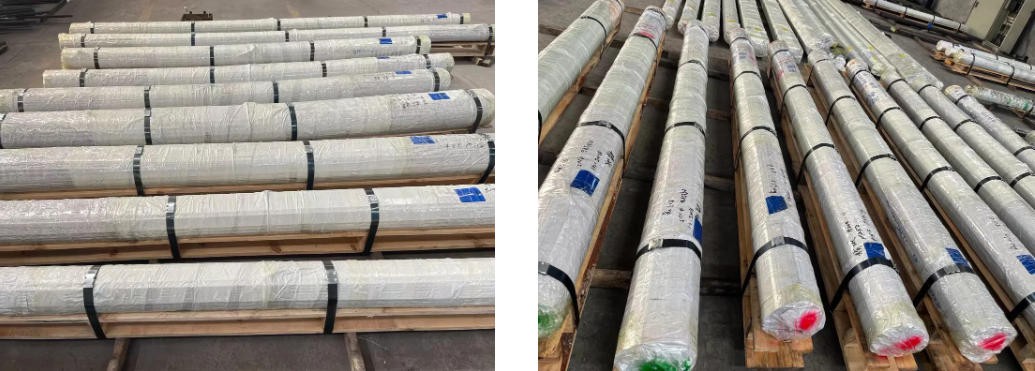
GNEE offers customized protection for 304/316 stainless steel bars: H8/H9 grade precision ground bars are packaged in single-layer PVC tubing + bubble wrap + IPPC-compliant fumigated wooden crates, ensuring zero surface scratches and salt spray resistance during long-distance sea transport; hot-rolled large-diameter bars are bundled with steel straps weighing up to 3 tons and equipped with double-layer nylon slings for easy loading and unloading. All packaging includes traceable furnace number tags, achieving zero-loss, high-precision delivery from the factory to the construction site.
FAQ
What is the key difference between 304 and 316L stainless steel bars?
304 (18/8): Contains 18% chromium and 8% nickel. It is the most commonly used stainless steel, offering good machinability and basic corrosion resistance. 316L builds upon the 304 composition by adding 2–3% molybdenum and increasing the nickel content. The addition of molybdenum provides superior resistance to pitting corrosion, particularly in environments containing chlorides (such as seawater or de-icing salts).
Why are 316L bars generally more expensive than 304 bars?
Cost of molybdenum: Molybdenum is an expensive alloying element, and 316L contains 2–3% of it.
Higher nickel content: 316L has a higher nickel content (10–14%) compared to 304 (8–11%). Fluctuations in nickel prices have a greater impact on the cost of 316L.
Typically, the unit price of 316L is 30% to 50% higher than that of 304.
Can 304 bars be used as a substitute for 316L?
For indoor use, or in ordinary fresh water or dry environments, substituting 304 for 316L can save costs while providing adequate performance.
However, in environments with high salt spray or acidity, 304 must absolutely not be used as a substitute for 316L; doing so would result in the rapid appearance of rust spots (pitting corrosion).
Send Inquiry