







316 Vs. 316L stainless steel pipes:semiconductor projects
Oct 08, 2026
Leave a message
If you are sourcing 316L stainless steel tubing for semiconductor fabs-whether for UHP gas, ultrapure water (UPW), chemical delivery, or equipment piping-price and wall thickness alone are not the only factors to consider. Semiconductor projects place greater emphasis on material cleanliness, internal surface roughness, electropolishing (EP) quality, weldability, particle control, clean packaging, and heat number traceability.
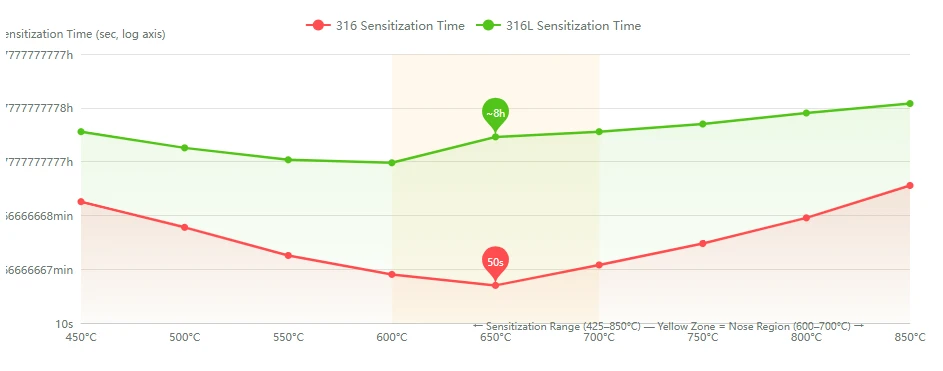
The sole fundamental difference between 316 and 316L lies in their carbon content (≤0.08% vs. ≤0.03%), yet this directly determines the risk of intergranular corrosion after welding. Grade 316 can undergo sensitization in just 50 seconds at 650°C, whereas 316L requires 8 hours; this thousand-fold difference is the primary reason why 316L is selected for semiconductor piping systems.
316 vs. 316L:Chemical Composition
| Element | 316 (wt%) | 316L (wt%) |
|---|---|---|
| Carbon (C) | ≤ 0.08 | ≤ 0.03 |
| Chromium (Cr) | 16.00–18.00 | 16.00–18.00 |
| Nickel (Ni) | 10.00–14.00 | 10.00–14.00 |
| Molybdenum (Mo) | 2.00–3.00 | 2.00–3.00 |
| Manganese (Mn) | ≤ 2.00 | ≤ 2.00 |
| Silicon (Si) | ≤ 0.75 | ≤ 0.75 |
| Phosphorus (P) | ≤ 0.045 | ≤ 0.045 |
| Sulfur (S) | ≤ 0.030 | ≤ 0.030 |
| Nitrogen (N) | ≤ 0.10 | ≤ 0.10 |
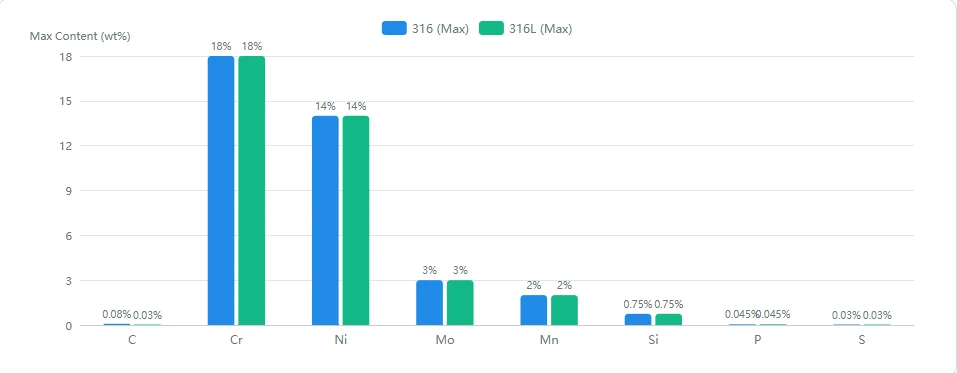
Note:Although the difference in carbon content is small (0.05 percentage points), it has a profound impact on the post-welding microstructure. Carbon combines with chromium to form Cr₂₃C₆ carbides (in which the chromium content can reach up to 70 wt%), leading to chromium depletion near the grain boundaries. Due to its low total carbon content, 316L forms a limited amount of carbides, resulting in a degree of grain-boundary chromium depletion that is far lower than that of 316.
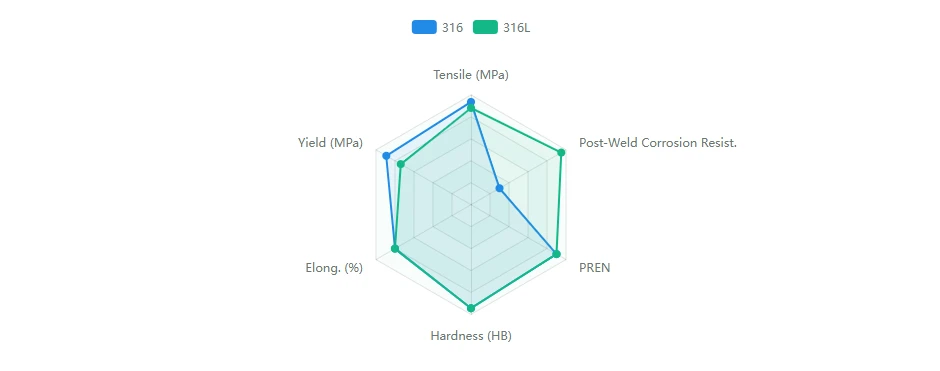
316 vs. 316L (Annealed, ASTM A269):Mechanical Property
| Property | TP316 | TP316L |
|---|---|---|
| Tensile Strength (min.) | 515 MPa | 485 MPa |
| Yield Strength, 0.2% (min.) | 205 MPa | 170 MPa |
| Elongation | ≥ 40% | ≥ 40% |
| Hardness (HB max.) | 217 | 217 |
| PREN | 25–28 | 25–28 |
316 vs. 316L: Sensitization and Intergranular Corrosion
When austenitic stainless steel is exposed to the temperature range of 425–850°C-a range inevitably traversed by the heat-affected zone (HAZ) during welding thermal cycles-carbon reacts with chromium to form chromium carbides (M₂₃C₆, primarily Cr₂₃C₆). These carbides precipitate along grain boundaries, with a chromium content reaching up to 70 wt%. This precipitation depletes chromium from the areas adjacent to the grain boundaries, creating a "chromium-depleted zone." In this zone, the chromium content falls below the 12.5% threshold required for passivation, leading to a significant reduction in corrosion resistance and resulting in intergranular corrosion (IGC).
| Grade | Carbon Content | Sensitization Time at 650°C | Relative Difference |
|---|---|---|---|
| 316 | ≤ 0.08% | ~50 seconds | 1× |
| 316L | ≤ 0.03% | ~8 hours | ~1,000× |
316 vs. 316L:Welding Performance Differences
Semiconductor piping systems utilize automatic orbital GTAW, requiring a large number of high-quality, repeatable welds. Welding performance is the decisive factor in the choice between 316 and 316L materials.
| Welding Performance | 316 | 316L |
|---|---|---|
| Post-Weld Sensitization Risk | High (~50 seconds at 650°C) | Very low (~8 hours at 650°C) |
| Post-Weld Intergranular Corrosion | Risk exists (weld decay) | High resistance |
| HAZ Sensitization (DOS) | May exceed 1% | <1% |
| Carbide Precipitation in Weld Zone | Significant (visible by SEM) | Trace amounts (difficult to detect by SEM) |
| Back-Purge Argon Protection | Required, with extended cooling | Required (standard procedure) |
| Post-Weld Corrosion Resistance | Reduced due to chromium depletion at grain boundaries | Generally maintained |
| Recommended Application | Non-welded applications or high-temperature strength requirements | Preferred choice for welded piping systems |
316 vs. 316L:Surface Treatment Differences
Both 316 and 316L can undergo bright annealing (BA) and electropolishing (EP). However, due to its lower carbon content, 316L generally provides a higher-quality passive film after electropolishing, resulting in better corrosion resistance.
| Treatment Method | 316 | 316L | Difference / Explanation |
|---|---|---|---|
| Bright Annealing (BA) | Available | Available | 316L generally provides a more uniform surface |
| Electropolishing (EP) | Available | Preferred | 316L forms a denser passive film after EP |
| Ra After EP (Standard) | ≤ 0.25 μm | ≤ 0.25 μm | Both can achieve the same surface roughness |
| Ra After EP (Premium) | ≤ 0.13 μm | ≤ 0.13 μm | 316L can more readily achieve this level consistently |
Why does the semiconductor industry almost exclusively use 316L instead of 316?
Semiconductor piping systems require extensive orbital welding, often involving thousands of weld joints. With grade 316, the heat-affected zone (HAZ) is highly susceptible to sensitization during welding-where chromium carbides precipitate along grain boundaries, leading to chromium depletion-resulting in a significant reduction in resistance to intergranular corrosion. In contrast, due to its extremely low carbon content, 316L exhibits a degree of sensitization (DOS) of less than 1% after welding, meaning its corrosion resistance remains essentially unchanged. Furthermore, semiconductor industry standards such as SEMI F20 and ASTM A270 explicitly specify the use of 316L.
Semiconductor Industry Standards for 316 and 316L
Semiconductor industry standards clearly favor 316L rather than 316 for high-purity piping applications:
| Standard | Specified Grade | 316 Applicable | 316L Applicable |
|---|---|---|---|
| SEMI F20 | 316L | No | Yes |
| ASTM A270 | 316L | No (316L required) | Yes |
| ASTM A312 | TP316 / TP316L | Yes (general-purpose piping) | Yes (general-purpose piping) |
| ASME BPE | 316L | No | Yes |
SEMI F20 specifies 316L for general-purpose, high-purity, and ultra-high-purity semiconductor piping applications, while 316 is not within its material scope. ASTM A270 sanitary tubing also specifies 316L for these applications. ASTM A312 is the main general-purpose piping specification that covers both TP316 and TP316L; however, semiconductor projects typically specify TP316L because of its lower carbon content, improved resistance to weld sensitization, and suitability for high-purity fabrication.
316 vs. 316L:Corrosion Data Comparison
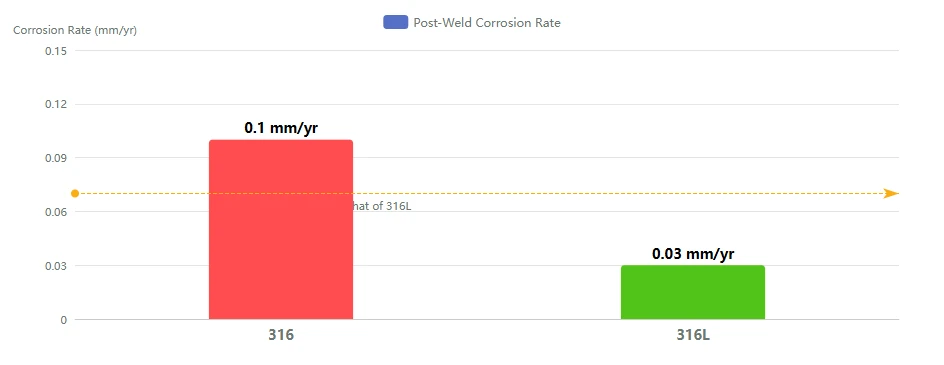
In the base-metal condition (without welding), 316 and 316L have very similar corrosion resistance, with PREN values typically in the range of 25–28. However, after welding, their corrosion rates can differ significantly in certain semiconductor-related environments.
| Medium / Condition | 316 | 316L |
|---|---|---|
| High-Purity Water / DI Water (After Welding) | 0.10 mm/year | 0.03 mm/year |
| 10% H₂SO₄, 60°C | - | 0.02 mm/year |
| NaCl Immersion | - | 0.4260 mpy |
| H₂SO₄ Immersion | - | 2.5141 mpy |
| Fluoride-Containing Medium, 50 ppm F⁻, 60°C | - | ~0.08 mm/year |
| Fluoride-Containing Medium, F⁻ > 2,000 ppm | - | >2 mm/year |
316L stainless steel pipe suppliers
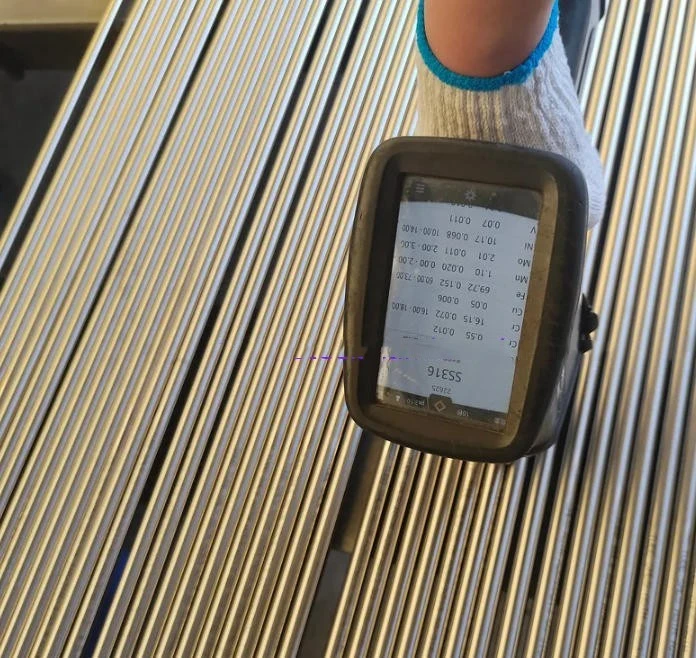
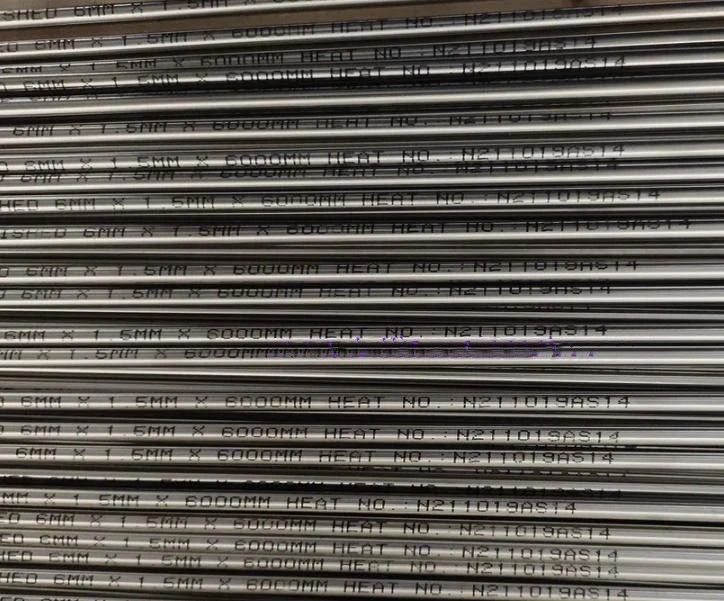
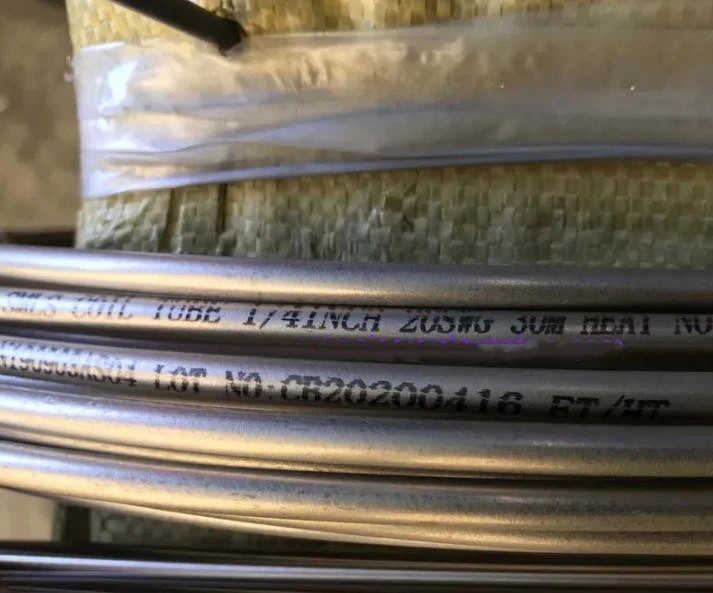
Gnee supplies 316L stainless steel pipes for semiconductor projects, covering high-purity process piping, gas distribution and UPW/DI water systems. Available options include ASTM A270, ASTM A312 and ASME BPE-compliant tubing, with BA/EP surfaces and controlled Ra ≤0.25 μm or ≤0.13 μm. Each batch can be supplied with EN 10204 3.1 MTC, PMI, dimensional inspection, surface roughness, hydrostatic/eddy-current testing and heat-number traceability, supporting high-purity fabrication and project QA requirements.
| Product Category | Surface Finish | Specification Standards | Size Range (OD) |
| BA Tube (Bright Annealed) | Ra ≤ 0.4 μm | ASTM A269 / A632 | 1/8" - 2" |
| EP Tube (Electro-Polished) | Ra ≤ 0.25 μm | ASTM A269 / SEMI F19 | 1/8" - 2" |
| Seamless Tube | Cold Drawn / Annealed | ASTM A269 | 6mm - 114.3mm |
| High Purity Gas Line | Passivated / Ultra-Clean | ASTM A632 / SEMI F20 | Customized |
| Coiled Tubing | Bright Annealed | ASTM A269 | 1/4" - 1/2" |
If you are planning or implementing a relevant project, please let me know:
• Are you responsible for specialty gas systems, ultrapure water systems, or vacuum/chemical piping?
• What is the approximate process node of the wafer fab (e.g., mature process or advanced nodes below 3nm)?
I can then provide you with more specific recommendations regarding standard equipment selection or installation.
FAQ
Q: How much more expensive is 316L compared to 316?
A: The price premium for 316L over 316 is approximately 15%, primarily due to the longer decarburization time required during AOD refining. Considering that the post-welding corrosion rate of 316L is one-third that of 316 (0.03 vs. 0.10 mm/year in ultrapure water) and that it eliminates the risk of rework and production downtime caused by weld sensitization, this 15% premium represents a highly cost-effective insurance investment for semiconductor projects.
Q: What is the difference between 316Ti and 316L?
A: 316Ti is a titanium-stabilized version of 316; titanium is added to preferentially bond with carbon, thereby preventing chromium carbide precipitation, making it suitable for welding. However, 316Ti is 15–30% more expensive than 316L [18], and the addition of titanium can negatively affect electropolishing (EP) results. The semiconductor industry predominantly chooses 316L over 316Ti because the low-carbon approach of 316L is more economical and yields superior EP finishes.
Q: What is "Dual Certified" 316/316L?
A: Some steel mills label batches with a carbon content of ≤ 0.03% as "Dual Certified" 316/316L. This means the batch meets both the strength requirements of 316 (though actual strength is slightly lower) and the carbon content requirements of 316L. To avoid confusion, it is recommended to specify 316L directly during procurement.
Q: What are the disadvantages of 316L at high temperatures (> 600°C)?
A: The yield strength of 316L degrades more rapidly at high temperatures (due to lower carbon content resulting in weaker solid-solution strengthening). For exhaust or waste gas piping operating above 600°C, 316 or 316H (high-carbon 316) is a more suitable choice. However, since process gas line temperatures within semiconductor fabs are typically below 200°C, this difference has no impact.
Q: What is the difference between 316L VIM-VAR and standard 316L?
A: Standard 316L is produced using AOD (Argon-Oxygen Decarburization) melting, whereas VIM-VAR utilizes a dual-process method-Vacuum Induction Melting (VIM) followed by Vacuum Arc Remelting (VAR)-to reduce oxygen content to ≤ 15 ppm and limit inclusion sizes to < 10 μm. Semiconductor UHP piping (for ALD/CVD precursors) requires VIM-VAR grade material, which commands a price premium of 30–50%.
Send Inquiry