

1.4404 vs 1.4462 Heat Exchanger Tube Selection
Apr 15, 2026
Leave a message
Quick answer: for a tube bundle in chlorinated cooling water, 1.4462 duplex is the better engineering choice - it resists pitting at the tube wall, tolerates higher velocity, and its higher strength allows a thinner wall. 1.4404 remains correct where the cooling medium is clean and low-chloride, where tubes must be welded to a 316L tubesheet without dissimilar procedure work, or where the exchanger operates above 300 C. The cost difference per square metre of surface is smaller than buyers expect, because duplex tubes are thinner.
1. Basic Definition and Metallurgical Characteristics
1.1 1.4404 (316L) tube
1.4404 tube is austenitic 316L, normally supplied 19.05 mm or 25.4 mm OD in 0.7-2.0 mm wall, annealed and pickled or bright annealed. Its advantage in a heat exchanger is predictability: it welds easily to 316L tubesheets, tolerates thermal cycling, and has decades of service history in clean water, steam and process fluids.
Its limitation is the tube wall itself - the thinnest section in the exchanger and therefore the first place chloride pitting appears. A 0.9 mm wall pits through in months under the wrong water chemistry, and the failure mode is a tube-to-shell leak that contaminates the process side.
1.2 1.4462 (2205) tube
1.4462 duplex tube offers PREN about 35, yield 450 MPa and roughly 1.4 times the thermal conductivity of austenitic grades. The higher strength supports thinner walls at the same design pressure, and the higher PREN plus hardness resists both pitting and erosion-corrosion at the tube inlet where velocity is highest.
Its price per tonne is similar to 316L, but the tube-making route is narrower: fewer mills draw duplex tubes, wall tolerances are tighter to hold, and tube-to-tubesheet welding requires ER2209 filler and controlled heat input.
2. Core Parameter Comparison
2.1 Chemical composition (wt%, ASTM A213 / A789)
| Element | 1.4404 tube | 1.4462 tube | Tube-making relevance |
|---|---|---|---|
| Cr | 16.0-18.0 | 21.0-23.0 | Pitting at the tube wall |
| Ni | 10.0-14.0 | 4.5-6.5 | Cost and structure |
| Mo | 2.00-3.00 | 3.0-3.5 | Chloride resistance |
| N | 0.10 max | 0.14-0.20 | Strength; phase balance after welding |
| C | 0.030 max | 0.030 max | Weld soundness in thin wall |
| S | 0.030 max | 0.020 max | Duplex limit suits thin-wall welding |
| PREN | about 25 | about 35 | The core selection number |
2.2 Mechanical and thermal properties
| Property | 1.4404 | 1.4462 | Effect on the exchanger |
|---|---|---|---|
| Yield strength (0.2%) | 170 MPa min | 450 MPa min | Duplex allows 0.5-0.9 mm wall vs 0.9-1.6 mm |
| Tensile strength | 485 MPa min | 620 MPa min | Vibration and pressure margin |
| Thermal conductivity | about 15 W/mK | about 21-23 W/mK | Duplex raises U by 3-6% at equal wall |
| Thermal expansion | about 16-17 x 10-6/K | about 13-14 x 10-6/K | Less differential expansion against steel shells |
| Elongation | 40% | 25% | Tube expansion into tubesheet is easier with 316L |
| Hardness | 160-185 HB | 240-270 HB | Duplex resists inlet erosion better |
| Max service temperature | about 870 C | about 300 C | Above 300 C only 316L is valid |
Two rows drive most of the economics: thinner wall reduces tube weight and improves heat transfer, and higher conductivity raises the U-value. Together they mean a duplex bundle can need 8-15% less surface area for the same duty, which offsets much of the price difference per tonne.
2.3 Corrosion performance in exchanger conditions
| Condition | 1.4404 | 1.4462 | Exchanger consequence |
|---|---|---|---|
| Clean cooling water, low chloride | Good | Good | 316L is sufficient and cheaper |
| Chlorinated cooling water, 40 C | Pits at tube wall | Good | The classic duplex upgrade |
| Chloride 500-1,000 mg/l, 60 C | Pits within 1-3 years | Good with flow | Duplex justified on shutdown avoidance |
| Deposit under fouling layer | Under-deposit pitting | Better, not immune | Cleaning regime still matters |
| Inlet velocity above 2 m/s with sand | Erosion-corrosion | Good to 3-4 m/s | Duplex allows smaller nozzles |
| Chloride SCC at tube wall | Risk above 60 C | Largely immune | The failure mode that destroys 316L bundles |
| Process side acidic | Limited | Limited | Neither: consider 904L or nickel alloy |
| Steam or hot oil above 300 C | Acceptable | Not suitable | Sigma embrittlement |
2.4 Tube-to-tubesheet welding and expansion
| Item | 1.4404 | 1.4462 | Practice |
|---|---|---|---|
| Filler | ER316L | ER2209 | Duplex filler must be available before the bundle starts |
| Heat input | Normal | 0.5-1.5 kJ/mm, tight | Orbital welding with recorded parameters |
| Interpass / shield | Argon purge | Argon purge plus controlled cooling | Ferrite check on the weld face |
| Tube expansion | Roller expansion, easy | Harder; higher forces required | Expansion may be replaced by welding |
| Dissimilar tubesheet | 316L to 316L, simple | Duplex tube to 316L sheet is a qualified dissimilar joint | Best practice: duplex tubesheet too |
| Repair plugging | Simple | Feasible but weld procedure needed | Plug material should match tube |
If the tubesheet stays 316L while the tubes are 2205, the joint is a dissimilar weld at the highest-consequence location in the exchanger, and it needs its own qualified procedure. Most operators that move to duplex tubes move the tubesheet as well, or at least the clad layer.
2.5 Cost per square metre of surface
Indicative FOB China, USD, 19.05 x 0.9 mm and 19.05 x 0.7 mm tube, 5-20 t.
| Item | 1.4404 tube | 1.4462 tube | Comment |
|---|---|---|---|
| Tube price per tonne | 4,700-5,600 | 4,900-5,900 | Similar per tonne |
| Wall used at 10 bar | 1.2 mm | 0.8 mm | Strength-driven |
| Weight per metre | 0.53 kg | 0.36 kg | About 32% lighter |
| Cost per metre | 2.49-2.97 USD | 1.76-2.12 USD | Duplex often cheaper in place |
| Surface area needed (equal U) | Reference | 8-15% less | Higher conductivity plus thinner wall |
| Life in chlorinated water | 2-5 years | 15-25 years | The lifecycle argument |
3. Applicable Duty and Selection Guide
3.1 Where 1.4404 tubes are correct
Clean cooling water below 200 mg/l chloride
Steam condensers and hot-oil coolers above 300 C
Food, dairy and pharmaceutical exchangers with full CIP
Refrigerant and HVAC duties
Exchangers with 316L tubesheets and no dissimilar procedure capability
Small replacement bundles where lead time matters more than life
3.2 Where 1.4462 tubes earn the upgrade
Chlorinated cooling water, especially with residual chlorine above 0.2 mg/l
Seawater and brackish water coolers
High inlet velocity with suspended solids
Bundles that have failed repeatedly by pitting or SCC
Pressure-limited designs where thinner wall reduces cost
Desalination and FGD auxiliary exchangers
Any duty where a tube leak contaminates the process side
3.3 Three-step selection test
| Step | Question | If yes | If no |
|---|---|---|---|
| 1. Water chemistry | Chloride above 300 mg/l, or chlorination practised? | 1.4462 tubes | Continue |
| 2. Metal temperature | Above 300 C on either side? | 1.4404 only | Continue |
| 3. Fabrication | Can the shop weld duplex tubes to the tubesheet with a qualified WPS? | 1.4462 with duplex tubesheet | 1.4404, and improve water treatment |
The third step decides more projects than the first two: a duplex bundle welded with an unqualified procedure is worse than a 316L bundle with good water treatment. Material choice without fabrication capability is theoretical.
4. What We Supply for Both Tube Grades
20+ years of manufacturing, 50+ export markets, 200+ energy and petrochemical projects delivered.
| Product | 1.4404 | 1.4462 | Standard |
|---|---|---|---|
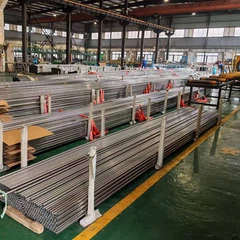
| Seamless tube | 6-219 mm OD, 0.7-3.0 mm wall | 6-219 mm OD, 0.7-3.0 mm wall | A213 / A789 |
| Welded tube | 12-630 mm OD | 12-630 mm OD | A249 / A789 |
| U-bent tubes | per drawing | per drawing | A213 / A688 |
| Fin tube | per drawing | per drawing | A213 base |
| Tubesheet plate | 20-150 mm | 20-100 mm | A240 |
Tube orders ship with eddy-current or hydrostatic test reports, wall tolerance and ovality data, and for duplex the ferrite content and phase balance of the finished tube. U-bends are stress relieved per code and dimensionally checked against the tube layout.
Send the exchanger datasheet: duty, water chemistry, chloride level, design pressure and temperature - we will calculate the wall each grade needs, the surface area difference and the cost per bundle. Tell us whether your shop can qualify a duplex tube-to-tubesheet procedure, because that decides the answer before metallurgy does.
5. FAQ: 1.4404 vs 1.4462 Heat Exchanger Tubes
Which tube grade for chlorinated cooling water?
1.4462 duplex. Chlorination raises the pitting potential at the tube wall, and 316L fails there within a few years while duplex holds 15-25 years. If the water is also warm, above 40 C, the case for duplex is stronger still because 316L then also risks chloride stress corrosion cracking.
Can duplex tubes be used with a 316L tubesheet?
Technically yes, with ER2209 filler and a qualified dissimilar procedure, but it creates a mixed joint at the highest-consequence location. Most operators specify a duplex or duplex-clad tubesheet so the weld is matching. If the tubesheet must stay 316L, the joint needs its own procedure qualification and ferrite check.
Why does duplex allow thinner tube walls?
Because its yield strength is 450 MPa against 170 MPa for 316L. At the same design pressure a 0.7-0.8 mm duplex wall replaces a 1.2 mm 316L wall, which reduces weight by about a third and improves heat transfer by shortening the conduction path.
Is duplex tube better for heat transfer?
Yes, marginally: its thermal conductivity is about 21-23 W/mK against 15 W/mK for 316L, and the thinner wall further reduces resistance. Combined, expect a 3-8% U-value improvement at equal service, which translates into less surface area for the same duty - though fouling usually dominates the real number.
What velocity can duplex tubes tolerate?
Generally 3-4 m/s with suspended sand, against about 2 m/s for 316L, because of higher hardness and better erosion-corrosion resistance. That allows smaller tube counts or smaller nozzles, but it does not remove the need for inlet impingement protection in severe service.
Are duplex tubes suitable above 300 C?
No. Long service above 300 C causes sigma precipitation and toughness loss, and most codes cap the grade accordingly. Exchangers with hot process sides - steam, hot oil, hot gas - should use 316L or a higher austenitic grade, regardless of the cooling water chemistry.
How do I detect a tube leak early?
By monitoring the process side for cooling-water ingress, and by eddy-current inspection at planned intervals. Duplex tubes usually fail by pitting at a discrete location rather than general wastage, so eddy-current testing detects them well before a through-wall leak, provided the baseline is recorded at installation.
What documents should come with the tubes?
MTR with PREN calculated, eddy-current or hydrostatic test report, dimensional record including wall tolerance, and for duplex the ferrite and phase-balance results plus impact test where specified. For U-bends, the bend radius check and heat treatment record matter as much as the tube certificate.


Send Inquiry