

1.4301 vs 1.4404 Stainless Steel: Composition & Selection
Apr 15, 2026
Leave a message
Quick answer: 1.4301 is EN 304 (UNS S30400) and 1.4404 is EN 316L (UNS S31603). They share the same austenitic structure and similar chromium and nickel levels, but 1.4404 carries 2.00-3.00% molybdenum and a maximum carbon of 0.030%. That single addition lifts PREN from about 18 to about 25 and is why 1.4404 survives chloride where 1.4301 pits. The cost is 30-40% per tonne, so the decision must be a calculation, not a habit.
1. Basic Definition and Metallurgical Characteristics of Both Grades
1.1 1.4301 (AISI 304): the general-purpose austenitic
1.4301, AISI 304, UNS S30400, is a chromium-nickel austenitic stainless steel with 17.5-19.5% chromium and 8.0-10.5% nickel, carbon up to 0.07%. Its structure is fully austenitic at room temperature, non-magnetic in the annealed condition, and it work-hardens rather than responds to heat treatment. Chromium forms the passive film; nickel stabilises the austenite and gives toughness; there is no molybdenum, which is the detail that decides everything on this page.
Strengths: wide availability in every product form, excellent formability and weldability, predictable behaviour, and the lowest cost of any austenitic grade in volume. It covers the majority of indoor, fresh-water, food-processing and architectural duty worldwide.
1.2 1.4404 (AISI 316L): the chloride-tolerant austenitic
1.4404, AISI 316L, UNS S31603, adds 2.00-3.00% molybdenum and holds carbon at 0.030% maximum, with chromium 16.0-18.0% and nickel 10.0-14.0%. Molybdenum strengthens the passive film against chloride attack and raises the pitting resistance equivalent number; the low carbon prevents chromium carbide precipitation at grain boundaries during welding, so the heat-affected zone keeps its corrosion resistance.
Strengths: roughy 1.4x the pitting resistance of 304, immunity to sensitisation at the thicknesses normally supplied, and acceptance across marine-adjacent, chemical, pharmaceutical and food industries. Limitation: it is not a seawater alloy. In stagnant chloride above about 500 mg/l, or where chlorides concentrate in a crevice, 1.4404 pits too.
2. Core Parameter Comparison
2.1 Chemical composition (wt%, EN 10088-2 / ASTM A240)
| Element | 1.4301 (304) spec | 1.4301 typical | 1.4404 (316L) spec | 1.4404 typical | Effect |
|---|---|---|---|---|---|
| C | 0.07 max | 0.045 | 0.030 max | 0.019 | Carbon control prevents weld sensitisation |
| Cr | 17.5-19.5 | 18.2 | 16.0-18.0 | 16.9 | Passive film; 1.4301 is actually higher |
| Ni | 8.0-10.5 | 8.1 | 10.0-14.0 | 10.3 | Austenite stability, toughness |
| Mo | - | 0.05 | 2.00-3.00 | 2.10 | The decisive difference: chloride resistance |
| Mn | 2.00 max | 1.40 | 2.00 max | 1.25 | Above spec signals grade substitution |
| Si | 0.75 max | 0.45 | 0.75 max | 0.40 | Weld pool behaviour |
| P | 0.045 max | 0.030 | 0.045 max | 0.028 | Hot cracking sensitivity |
| S | 0.030 max | 0.002 | 0.030 max | 0.001 | Inclusions act as pit initiation sites |
| N | 0.10 max | 0.045 | 0.10 max | 0.040 | Minor austenite stabiliser, small PREN effect |
Read the table carefully: 1.4301 actually has more chromium than 1.4404. Chromium alone does not decide chloride performance - molybdenum does. A buyer who compares only chromium content will conclude 304 is better, which is the most common technical error in this comparison.
2.2 Room-temperature mechanical properties
| Property | 1.4301 min | 1.4301 typical | 1.4404 min | 1.4404 typical |
|---|---|---|---|---|
| Tensile strength | 515 MPa | 600-700 MPa | 485 MPa | 580-670 MPa |
| Yield strength (0.2%) | 205 MPa | 250-310 MPa | 170 MPa | 245-300 MPa |
| Elongation A80 | 40% | 45-55% | 40% | 46-55% |
| Hardness | 201 HBW max | 155-180 HB | 217 HBW max | 160-185 HB |
| Young's modulus | - | about 193 GPa | - | about 193 GPa |
| Thermal expansion 20-100 C | - | about 16.0 x 10⁻⁶/K | - | about 16.0 x 10⁻⁶/K |
Mechanically the two grades are near-identical in practice. The minimum yield of 1.4404 is nominally lower because of the low carbon, but delivered values sit in the same band, and neither grade can be strengthened by heat treatment. Any design that relies on tensile strength above 300 MPa at service temperature needs a different alloy family, not a switch between these two.
2.3 Corrosion resistance and PREN
PREN = Cr + 3.3 x Mo + 16 x N.
| Index | 1.4301 | 1.4404 | What the number means |
|---|---|---|---|
| PREN (typical) | about 18.1 | about 24.9 | Roughly 1.4x pitting resistance |
| Chloride tolerance, ambient, no crevice | up to about 200 mg/l | up to about 500 mg/l | Above these, pitting starts in wet deposits |
| Chloride + 60 C | about 100 mg/l | about 300 mg/l | Temperature cuts the threshold |
| Stagnant seawater | Fails | Fails | Neither grade is a seawater alloy |
| Chloride SCC (austenitic) | Risk above 60 C and 200 mg/l | Risk above 60-70 C | Mo delays, does not prevent, SCC |
| Intergranular corrosion after welding | Risk above about 6 mm section | Low risk | Carbon 0.030% is the mechanism |
| Atmospheric rural / urban | Good | Good | Both are adequate indoors |
| Coastal atmosphere 1-10 km | Staining within months | Staining after years | The visible difference clients notice |
The practical translation for a buyer: if the part is indoors, washed with potable water and never sees salt or chloride sanitiser, 1.4301 will last. If it sees coastal air, de-icing salt, chlorinated cleaning agents, brine or acidic product, 1.4404 earns its premium within the first maintenance cycle - and the value is not the metal, it is avoiding a shutdown.
2.4 Welding, machining and forming
| Process | 1.4301 | 1.4404 | Practical note |
|---|---|---|---|
| TIG / MIG welding | Wide window, tolerant of heat input | Normal window; keep interpass under 150 C on thick sections | Both use 308L or 316L filler respectively |
| Post-weld treatment | Not needed to 6 mm; anneal above that if code requires | Not needed at any normal gauge | Pickle and passivate both, always |
| Machining | Gummy, built-up edge likely | Slightly harder, better chip breaking | Neither is free-cutting; that is 1.4305 |
| Deep drawing | Excellent | Good, marginally higher springback | 1.4307/1.4404 for heavy draws |
| Polishing to mirror | Responds well | Responds well, slightly slower | Hardness difference is small |
| Thermal conductivity | about 16 W/mK | about 15 W/mK | Both poor conductors; affects welding heat |
2.5 Raw material price and lifecycle cost
Indicative FOB China, USD per tonne, 2B sheet 1-2 mm, 3-15 t lot. Prices move with the nickel and molybdenum indices; the gap is what matters, not the absolute number.
| Item | 1.4301 | 1.4404 | Comment |
|---|---|---|---|
| Metal price (indicative) | 2,450-2,800 | 3,150-3,550 | 1.4404 is 1.25-1.40x of 1.4301 |
| Difference per tonne | - | +600 to +900 | Driven by Mo plus higher Ni |
| Fabrication cost | Baseline | +3-8% | Harder machining, slower polishing |
| Expected life, indoor potable water | 20+ years | 25+ years | Both exceed equipment life; no payback |
| Expected life, coastal or chloride | 2-5 years to first pitting | 8-15 years | 1.4404 pays back in one avoided replacement |
| Repair cost per pitting event | Welding plus re-passivation, plus downtime | Rare | Downtime normally exceeds metal cost |
The lifecycle argument only works where the failure mode is real. On a dry indoor handrail, paying 35% more for 1.4404 buys nothing measurable - which is why the honest recommendation is duty-based, not always upgrade.
3. Applicable Duty and Selection Guide
3.1 Where 1.4301 is the correct answer
Indoor architectural panels, balustrades, lift interiors, signage
Kitchen equipment and domestic sinks in potable water
Dairy and brewery lines with neutral cleaning and full rinse
Heat exchanger shells on closed-loop, low-chloride water
Dry bulk handling, hoppers, chutes, conveyor frames
Furniture, sanitary ware bodies, appliance trim
General pipework and fittings below 100 mg/l chloride
Automotive trim, railway interior components
3.2 Where 1.4404 is required
Coastal and offshore-adjacent structures within the splash envelope
Brine, pickle and salt handling tanks
Pharmaceutical process contact surfaces cleaned with hypochlorite
Food plants using chlorinated sanitisers on warm surfaces
Chemical process lines with dilute chloride at 40-80 C
Desalination pre-treatment and low-pressure stages
Marine exhaust components and scrubber internals above the waterline
Medical equipment housings and sterilisation containers
3.3 Three-step selection test
| Step | Question | If yes | If no |
|---|---|---|---|
| 1. Chemistry | Chloride above 200 mg/l, or acidic product below pH 4? | Move to 1.4404 | Continue to step 2 |
| 2. Geometry | Any crevice, lap joint, gasket line or stagnant leg? | 1.4404 plus design change to remove the crevice | Continue to step 3 |
| 3. Temperature | Service above 50 C with any chloride present? | 1.4404 minimum; check SCC above 60 C | 1.4301 is adequate |
4. What We Supply for Both Grades
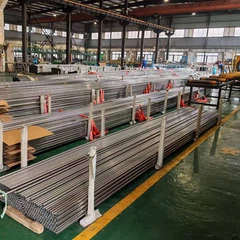
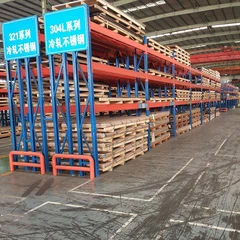
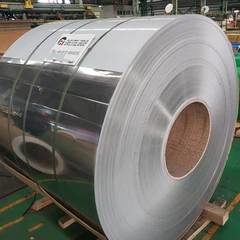
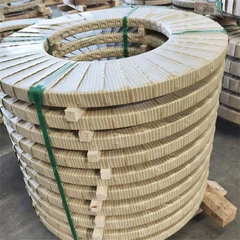
GNEE STEEL supplies 1.4301 and 1.4404 in sheet, plate, coil, strip, bar, wire and pipe, with 20+ years of manufacturing, exports to 50+ countries and 200+ delivered projects in energy and petrochemical service.
| Product form | Thickness / size | Finish | Standard |
|---|---|---|---|
| Cold-rolled sheet | 0.3-3.0 mm | 2B, BA, No.4, 8K | ASTM A240, EN 10088-2 |
| Hot-rolled plate | 3.0-80 mm | No.1, 2D | ASTM A240, EN 10028-7 |
| Coil and slit strip | 0.3-6.0 mm, from 20 mm wide | 2B, 2D | A240 / A480 |
| Round and flat bar | 6-250 mm | Peeled, ground | A276, A479 |
| Wire | 0.1-10 mm | Bright, annealed, spring | A580, EN 10270 |
| Welded / seamless pipe | 6-630 mm OD | Pickled, polished | A312, A213, A249 |
Documentation on every order: MTR 3.1 per heat with molybdenum and PREN data where 1.4404 is ordered, PMI on request, dimensional record, and third-party inspection by SGS, BV or TUV when the project requires it.
Send the medium, chloride level, temperature and product form - we will confirm in writing whether 1.4301 or 1.4404 is the correct grade and quote both so you can see the real gap. Include the part drawing and we will add the tolerance, finish and document list in one reply.
5. FAQ: 1.4301 vs 1.4404
Is 1.4404 simply a better 1.4301?
No. It is more resistant to chloride pitting, but it costs 25-40% more, machines slightly harder and offers no measurable benefit in dry or potable-water service. In a low-chloride indoor application the extra money buys nothing; in a brine or coastal application it is the difference between years and months.
Why does 1.4301 have more chromium than 1.4404?
Because chromium is not the only protection mechanism. 1.4301 is specified at 17.5-19.5% Cr while 1.4404 is 16.0-18.0%, but 1.4404 adds 2-3% molybdenum, which is roughly 3.3 times as effective per percent in the PREN formula. Comparing only chromium content is the classic error in this comparison.
Can 1.4404 be used in seawater?
Only in the splash and atmospheric zone, and only with regular washing. In continuous immersion, or in a wet crevice under marine growth, 1.4404 pits and suffers crevice corrosion. Immersed seawater service needs 6Mo super austenitic, duplex 2205 or a super duplex grade.
What is the chloride limit for each grade?
As a working rule at ambient temperature: about 200 mg/l for 1.4301 and about 500 mg/l for 1.4404, with no crevice and regular flow. At 60 C those fall to roughly 100 and 300 mg/l. These are engineering rules of thumb, not code limits - the design standard for your industry governs.
Does the price difference ever disappear?
Rarely, and only temporarily. The gap follows the molybdenum and nickel indices, so it widens when Mo spikes and narrows in a soft alloy market. A quote that shows 1.4404 at 1.4301 prices should be treated as a chemistry question - ask for the Mo figure on the MTR before accepting.
Which grade for a coastal hotel kitchen?
1.4404. Coastal air plus chlorinated sanitiser plus warm surfaces is exactly the combination that pits 1.4301 within a couple of years, usually at a weld or under a fixing. It is the single most common upgrade we quote and the one with the clearest payback.
Can both grades be welded to each other?
Yes, with 316L filler and a procedure that keeps dilution in mind: welding 1.4404 to 1.4301 with 308L filler leaves the joint with reduced molybdenum where it matters most. For any joint exposed to chloride, specify 316L consumables even when one side is 1.4301.
What documents prove the grade?
MTR 3.1 per heat showing chromium, nickel and molybdenum, plus PMI on the finished part. Chemistry is the only reliable proof: colour, magnet response and spark tests cannot separate 304 from 316, and grade substitution is a real commercial risk in this segment.


Send Inquiry